
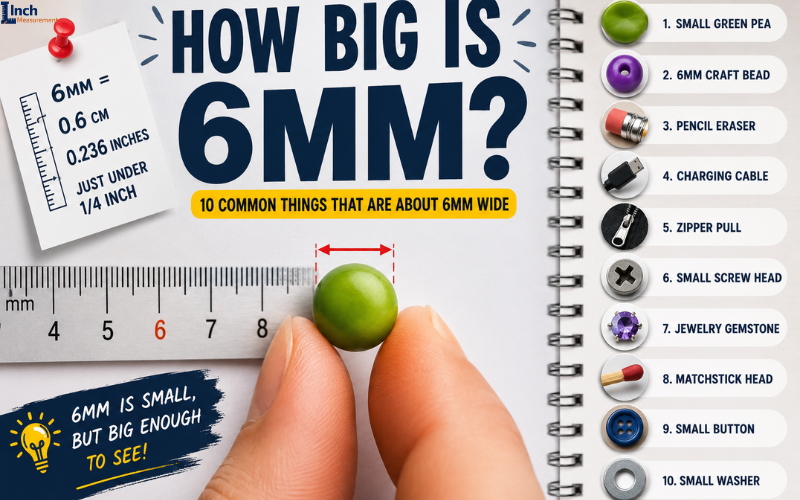
6mm is 0.6 centimeters, approximately 0.236 inches, or just under 1/4 inch. It is a small measurement, but it is large enough to see easily with your eyes. If you need a quick way to picture it, think of a small green pea or a 6mm craft bead.
Millimeters are commonly used for small objects where inches or centimeters may not give enough detail. You may see 6mm used for jewelry, beads, screws, cables, zipper parts, and other small items. The number can be difficult to visualize on its own, especially when shopping online.
A real-life comparison makes the measurement much easier to understand. The examples below show what 6mm can look like and explain where you may actually come across this size.
6mm Conversion at a Glance
If you normally use inches, the easiest number to remember is 6mm ≈ 0.236 inches. You can also think of it as being slightly smaller than 1/4 inch.
For metric measurements, 6mm = 0.6cm. Since there are 10 millimeters in a centimeter, six millimeters is a little over half a centimeter.
What Does 6mm Look Like?
So, how big is 6mm when you see it in real life?
A 6mm measurement is small enough to fit across a small part of your fingertip, but it is not microscopic. You can normally see a 6mm object clearly without magnification.
A round object measuring 6mm across has a diameter of 6mm. This is why beads and gemstones are particularly useful comparisons. A seller may describe a round bead as “6mm,” meaning the distance from one side of the bead to the other is approximately 6mm.
Other objects can use the same measurement differently. A cable might be 6mm thick, a small component might be 6mm wide, or a piece might be 6mm long.
That distinction matters if you are buying something online. A product described as 6mm is not necessarily 6mm in every direction. Always check which dimension the measurement refers to.
6mm Comparison Table
Here is a quick look at the 10 examples below:
| Common Item | Approximate 6mm Comparison | About 6MM |
|---|---|---|
| Small green pea | Width/diameter | 6MM |
| 6mm craft bead | Diameter | 6MM |
| Small pencil eraser | Width | 6MM |
| Charging cable | Outside thickness | 6MM |
| Small zipper pull | Width | 6MM |
| Small screw head | Head width | 6MM |
| Jewelry gemstone | Diameter | 6MM |
| Matchstick head | Width | 6MM |
| Small round button | Width | 6MM |
| Small hardware washer | One measured dimension | 6MM |
The table is meant for quick visualization. The everyday items themselves can vary, so the 6mm craft bead is the better choice when you want an object that is actually manufactured to the stated measurement.
10 Common Things That Are About 6mm Wide
The following objects can help you picture 6mm without constantly looking at a ruler. Keep in mind that most everyday objects vary in size, so these are visual comparisons rather than exact standards.
1. Small Green Pea
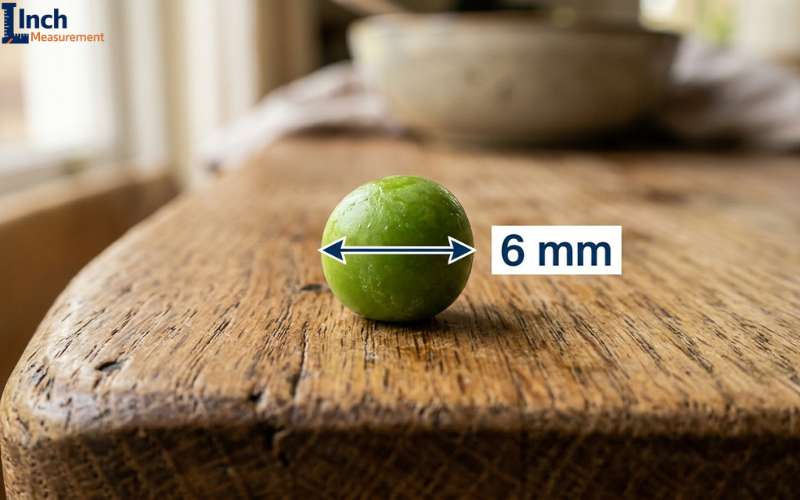
A small green pea is one of the easiest ways to imagine something around 6mm wide.
Because a pea is roughly round, you can compare its diameter with the width of a 6mm object. Some peas will be smaller than 6mm, while others will be larger, so it should only be used as an approximate reference.
The advantage of this comparison is that peas are familiar. You do not need to understand millimeters to get a basic idea of the size.
If you are trying to picture a small round bead or gemstone, imagine something about the width of a small pea. That gives you a much more useful mental image than simply hearing the number “6mm.”
A pea is also a good reminder that 6mm is small but still noticeable. You can easily pick one up, see its shape, and compare it with another small object.
For an exact measurement, however, use a ruler or another measuring tool. Natural objects are not made to precise dimensions.
2. 6mm Craft Bead
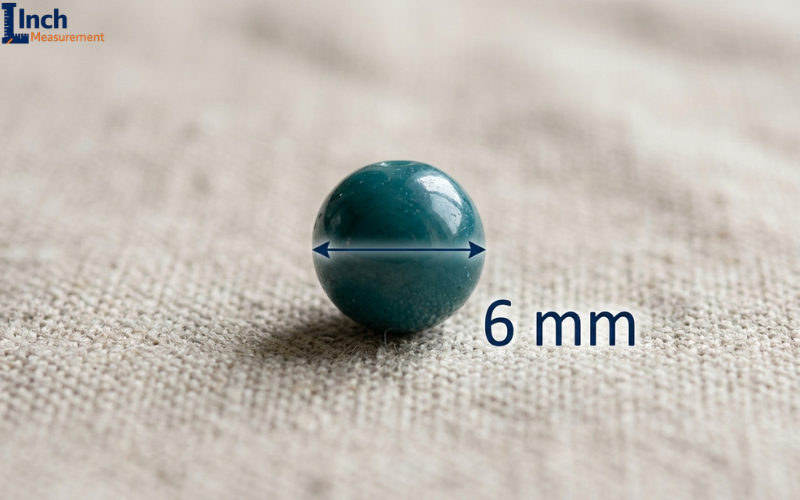
A 6mm craft bead is one of the best examples because the size is specifically stated.
Round beads are commonly sold in millimeter sizes such as 4mm, 6mm, 8mm, and 10mm. If you have handled different bead sizes before, you can use those numbers to understand how small 6mm really is.
A 6mm bead is small enough for detailed jewelry designs but large enough to see and handle without much difficulty. It can be used for bracelets, necklaces, earrings, and decorative crafts.
This is also a useful example if you are searching for how big is 6mm in inches. A 6mm bead has a diameter of about 0.236 inches.
Online product photos can make beads look much larger than they really are because the photograph may be enlarged. Checking the millimeter measurement gives you a more realistic idea of what will arrive.
If you need a reliable visual reference, a labeled 6mm bead is better than guessing from a photograph or comparing it with an object that varies in size.
Related Post: 8 Common Things That Are 5mm Big
3. Small Pencil Eraser
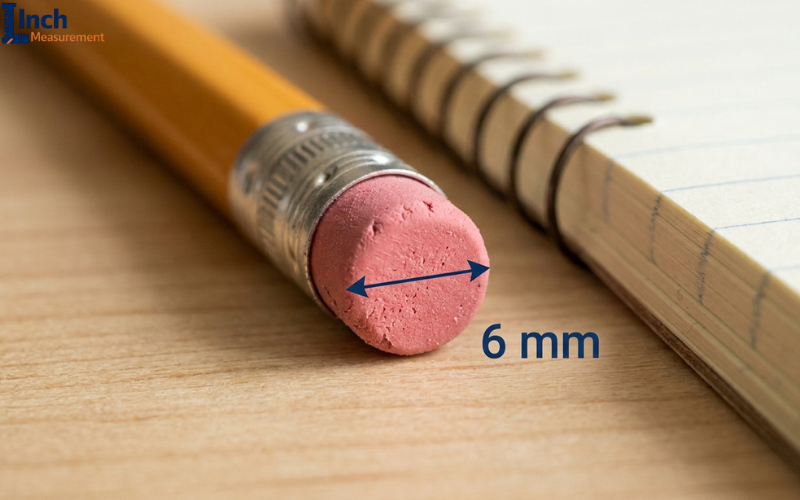
A small section of a pencil eraser can give you a rough idea of the size of 6mm.
Pencils are common in schools, offices, workshops, and homes, so they are convenient objects for making quick comparisons. The exact width of a pencil eraser varies by pencil design, which means you should not treat one as a precise 6mm measuring tool.
Still, looking at a small eraser can help you understand the scale. Six millimeters is not an extremely tiny distance. It is enough to cover a visible section of a small stationery item.
This example can also help when explaining millimeters to someone who normally thinks in inches or centimeters. Instead of giving them only the conversion, you can show them a familiar object and say that 6mm is around that scale.
For school projects, crafts, or anything that requires an exact measurement, use an actual ruler. A pencil is useful for visualization, not precision.
4. Charging Cable
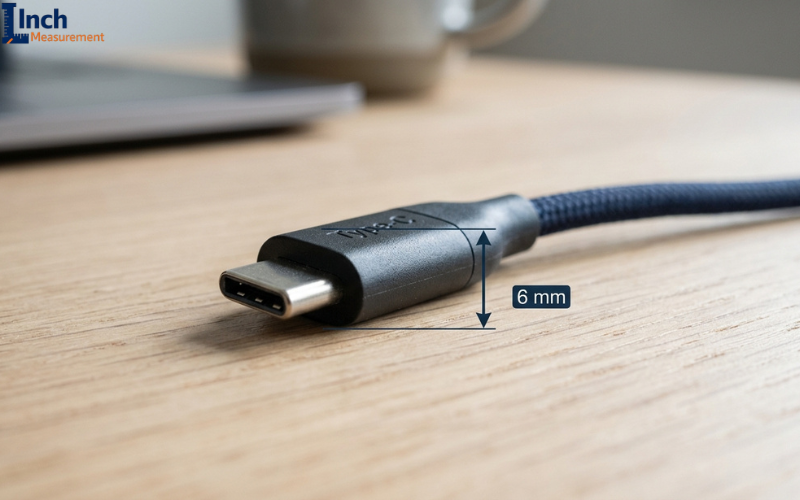
Some charging cables can be close to 6mm in outside diameter. This gives you a useful example of 6mm as a thickness rather than a length.
A cable around this size looks fairly slim when compared with larger cords, but it is still easy to see and handle. The outer covering protects the wires inside, so the actual construction can vary significantly from one cable to another.
Do not assume that every phone or tablet charging cable is 6mm. Cable diameter depends on its design, insulation, internal wires, and manufacturer.
This comparison becomes useful when you are checking whether a cable will fit through a hole, clip, cable sleeve, or organizer. If the opening is tight, you should measure the actual cable rather than rely on a visual estimate.
A 6mm cable would be about 0.236 inches across, which is slightly less than 1/4 inch.
5. Small Zipper Pull
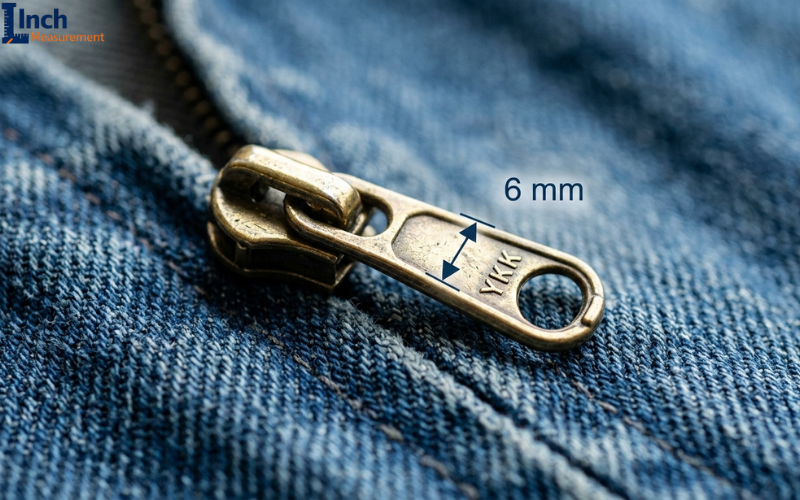
A small zipper pull can be around 6mm wide, depending on the design. Zipper components appear on jackets, backpacks, purses, cosmetic bags, and other everyday products.
A small zipper part is a useful reference because it shows how compact 6mm is while still being large enough to see and handle easily.
The exact size of zipper components varies considerably. If you are purchasing a replacement zipper, do not assume that a listing mentioning 6mm means the pull itself is 6mm.
The measurement may refer to the zipper teeth, slider, tape, or another part. Check the manufacturer’s dimensions or diagram before ordering if the replacement needs to fit a specific item.
As a general visual comparison, though, a small zipper component can give you a good idea of what a 6mm measurement looks like between your fingers.
Related Post: 8 Common Things That Are 7mm Big
6. Small Screw Head
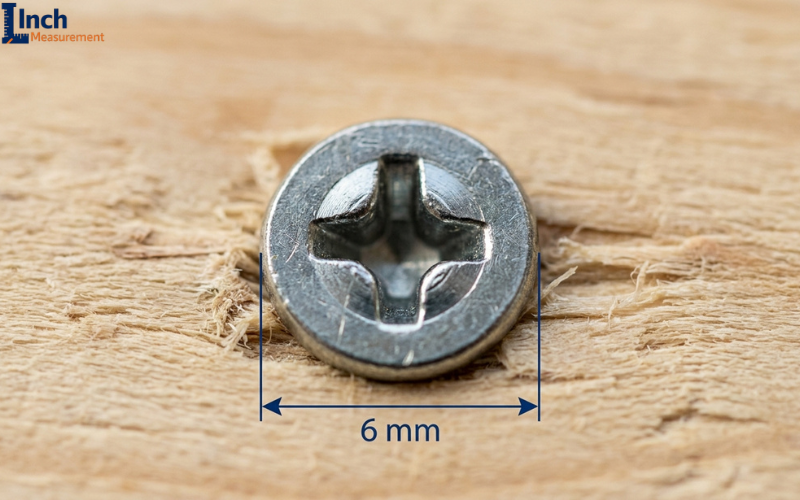
Some small screw heads can measure around 6mm across. Small screws are found in electronics, toys, appliances, furniture hardware, and many DIY projects.
A screw head this size is compact compared with ordinary construction screws. You can see it easily, but it is still small enough to be used in products where larger hardware would not fit.
This example shows why it is important to understand exactly what a measurement describes.
If a screw is listed as 6mm, that does not necessarily mean the entire screw is 6mm long. The number might refer to the head diameter, shaft diameter, thread size, or another dimension.
For example, a screw could have a head that is around 6mm across while the screw itself is several centimeters long.
If you are replacing hardware, check all the dimensions before buying. A visual comparison is useful for understanding size, but it cannot tell you whether a particular screw will fit.
7. 6mm Jewelry Gemstone
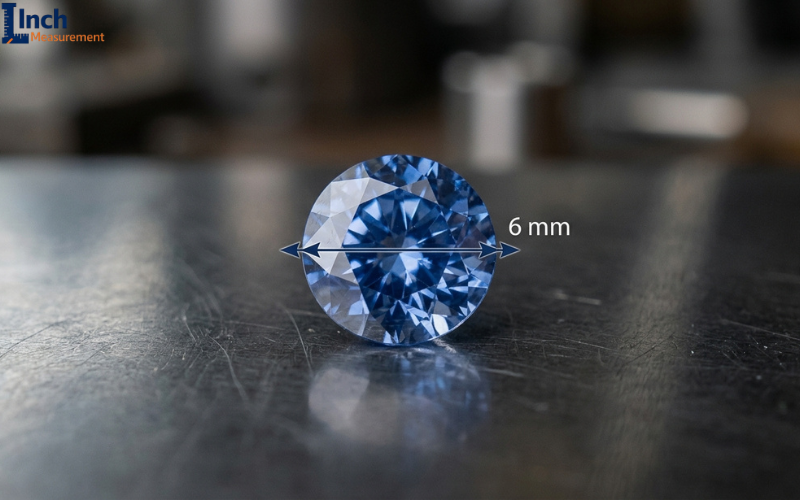
A 6mm round gemstone is another excellent way to understand the measurement.
Jewelry stones are often measured in millimeters because small differences in size can change their appearance. A 4mm stone, 6mm stone, and 8mm stone may all sound small, but the difference is easy to notice when they are placed side by side.
A 6mm stone has a diameter of approximately 6mm. In inches, that is about 0.236 inches.
This size can be used for earrings, pendants, rings, bracelets, and other jewelry. It is noticeable without being especially large.
If you are buying jewelry online, be careful with product photos. Close-up images often make small stones appear much bigger than they really are.
Checking the listed diameter is a better way to understand what you are purchasing. If the seller says a round stone is 6mm, imagine a circle just under 1/4 inch across.
8. Matchstick Head
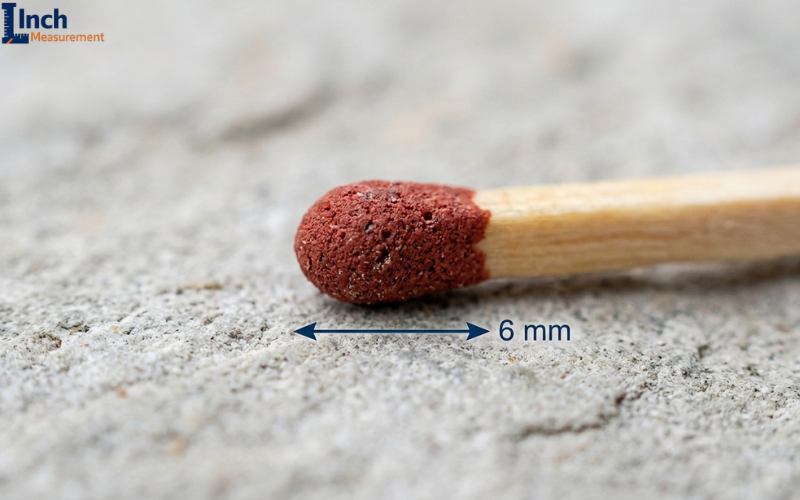
The head of a matchstick can provide another rough comparison for 6mm.
A match head is small and rounded, making it easy to compare visually with a bead or gemstone. However, matchsticks vary in design, so you should not expect every match head to measure exactly 6mm.
This comparison is mainly useful for answering the question, “What does 6mm look like?”
If you place a matchstick head beside a known 6mm object, such as a labeled craft bead, you can get a better sense of the scale.
The important point is that 6mm is small enough to be comparable with tiny household components, but it is still a clearly visible distance.
9. Small Round Button
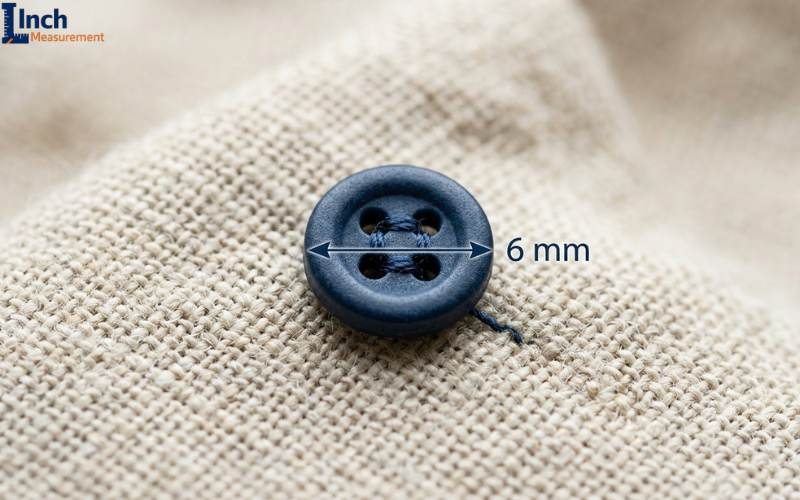
A small round button can sometimes be close to 6mm in one dimension, particularly very small buttons used on clothing, crafts, or decorative projects.
Buttons come in many sizes, so most will be considerably larger than 6mm. This example is useful only when referring to a genuinely small button.
If you are working on a sewing project, check the button’s actual dimensions rather than estimating its size from appearance. A difference of a few millimeters can affect whether a button fits a particular buttonhole.
A 6mm button would be extremely small compared with the large buttons commonly found on coats or shirts.
This makes it another useful comparison for understanding the scale of the measurement. Six millimeters is a small distance, but it is still practical for tiny manufactured parts.
See Also: 10 Common Things That Are 8mm Big
10. Small Hardware Washer
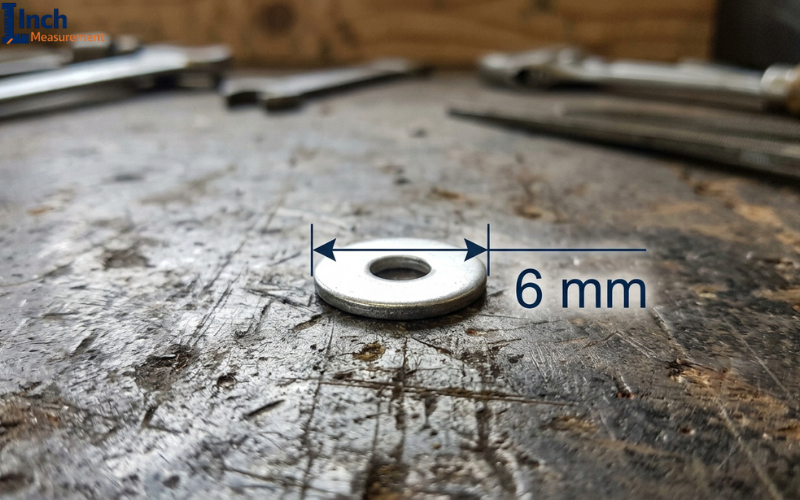
A small washer can have a width or thickness close to 6mm, depending on its type and purpose.
Washers are used with screws and bolts to spread pressure and protect surfaces. They come in many different sizes, so a 6mm measurement may refer to the inner diameter, outer diameter, or thickness.
That makes washers a good example of why you should always check the complete specifications.
If a washer is described as having a 6mm inner diameter, that does not mean the entire washer is 6mm wide. Its outside diameter will normally be larger.
For a general visual reference, a small washer around this size shows how millimeters are used to describe compact mechanical parts.
How Long Is 6mm?
If you are asking how long is 6mm, imagine a straight line measuring just under 1/4 inch.
The exact conversions are:
- 6mm = 0.6cm
- 6mm = 0.006m
- 6mm ≈ 0.236 inches
- 6mm is slightly shorter than 1/4 inch
The phrase “how long” does not mean that the object must be long and narrow. It simply refers to a distance of 6mm.
For example, a tiny piece of material could be 6mm long. A round bead could be 6mm in diameter. A cable could be 6mm thick.
Always check which dimension is being described.
How Far Is 6mm?
6mm is 0.6 centimeters, or about 0.236 inches. That is a very short distance.
If you are more familiar with imperial measurements, think of 6mm as slightly less than 1/4 inch.
A quarter inch equals 0.25 inches, while 6mm equals about 0.236 inches. The difference is small enough that they may look nearly identical when compared by eye.
For casual size comparisons, “about a quarter inch” can be a useful shortcut. For precision work, though, do not treat the two measurements as exactly equal.
This matters for things like drill bits, screws, holes, jewelry settings, and other parts where a small difference can affect whether something fits.
How to Estimate 6mm Without a Ruler
You can make a rough estimate of 6mm using familiar objects, but these methods are not suitable for precision work.
Use a 6mm Bead
A labeled 6mm bead is one of the best visual references. Since its diameter is specifically measured, you know you are comparing against a known size.
If you regularly work with small measurements, keeping a few beads of different sizes can help you develop a better sense of scale.
Compare It With a Small Pea
A small pea is useful for a quick estimate. Place the object beside the pea and compare their widths.
Remember that peas naturally vary. One may be close to 6mm while another may be noticeably larger.
Think About 1/4 Inch
If you are more comfortable with inches, remember that 6mm is just under 1/4 inch.
This is probably the simplest mental shortcut. You do not need to picture six individual millimeters. Instead, picture a quarter inch and make it slightly smaller.
Use Your Fingertip as a Rough Reference
Your fingertip can help you understand the general scale of a few millimeters, but it should not be used as a measuring device.
Finger and fingernail sizes differ from person to person. Use this only when you need a rough visual estimate.
6mm Compared With Nearby Measurements
Seeing 6mm alongside similar measurements helps show exactly where it falls.
| Measurement | Inches | Centimeters |
|---|---|---|
| 3mm | 0.118 in | 0.3 cm |
| 4mm | 0.157 in | 0.4 cm |
| 5mm | 0.197 in | 0.5 cm |
| 6mm | 0.236 in | 0.6 cm |
| 7mm | 0.276 in | 0.7 cm |
| 8mm | 0.315 in | 0.8 cm |
| 9mm | 0.354 in | 0.9 cm |
| 10mm | 0.394 in | 1.0 cm |
The difference between nearby millimeter sizes can matter more than you might expect.
For example, a 6mm bead will look different from a 4mm bead. An 8mm bead will also look noticeably larger. This is why manufacturers often use millimeters for small products instead of rounding everything to centimeters.
6mm vs. 5mm
5mm equals 0.5cm, while 6mm equals 0.6cm.
The difference is only 1mm, but 6mm is 20% wider than 5mm when comparing objects of the same shape.
With jewelry beads or gemstones, that small numerical difference can produce a noticeable change in appearance.
6mm vs. 8mm
8mm equals 0.8cm, so it is 2mm larger than 6mm.
That difference represents one-third of the original 6mm measurement. As a result, an 8mm round bead will generally look noticeably larger than a 6mm bead.
If you are choosing between these sizes for jewelry, comparing actual beads side by side is the easiest way to see the difference.
6mm vs. 10mm
10mm equals 1cm, while 6mm equals 0.6cm.
That means 10mm is significantly larger. A round 10mm object will have a much greater diameter than a 6mm object.
Remembering that 10mm is exactly 1 centimeter can also give you a convenient reference when estimating other metric measurements.
When Is Knowing 6mm Useful?
Knowing what 6mm looks like is especially useful when a product is too small to judge accurately from a photograph.
Jewelry Shopping
Gemstones, beads, pearls, and other jewelry components are commonly measured in millimeters.
If a product says the stone is 6mm, you can expect a diameter of about 0.236 inches if it is round.
This helps prevent disappointment when a close-up product photo makes the stone look much larger.
Craft Projects
Bead sizes can change the entire appearance of a bracelet, necklace, or decorative project.
A 6mm bead is a useful middle-ground size. It is noticeably larger than tiny beads but still relatively compact.
Small Hardware
Millimeters are common in hardware specifications. Screws, washers, nuts, connectors, and other parts may have several dimensions listed in mm.
Do not assume that the first number you see describes the object’s total size. Read the complete specification.
Cable Fitting
If you are trying to fit a cable through an opening, the cable’s outside diameter matters.
A 6mm cable is just under 1/4 inch thick. If the opening is close to that size, you should measure both before deciding that they will fit.
DIY and Repairs
Small repair projects often require precise measurements. Knowing the approximate size of 6mm helps you understand the part you need, but an actual measuring tool is better when a close fit is required.
Common Mistake: 6mm vs. 6cm
Do not confuse 6mm with 6cm.
They are very different:
6mm = 0.6cm
6cm = 60mm
So 6cm is 10 times longer than 6mm.
This is an easy mistake to make when reading a product description quickly. Always check whether the seller uses mm or cm before ordering.
Common Mistake: Assuming 6mm Describes the Whole Object
A product can have one dimension of 6mm without being 6mm overall.
For example:
- A screw head can be 6mm wide but several centimeters long.
- A cable can be 6mm thick but several meters long.
- A bead can be 6mm across while having a central hole.
- A washer can have a 6mm inner diameter but a much larger outside diameter.
This is why the complete product dimensions are more useful than a single number.
Common Mistake: Judging From a Product Photo
Online photographs can make small objects look much larger than they really are.
A 6mm gemstone photographed close-up may fill much of your screen even though it is less than 1/4 inch across.
Always check the written dimensions. If possible, compare the listed size with an object you already have at home.
More useful Measurements Guide:
- 9 Common Things That Are 3mm Big
- 9 Common Things That Are 2mm Big
- 9 Common Things That Are 1mm Big
- 10 Common Things That Are 10cm
- 9 Common Things That Are 5cm Big
- 9 Common Things That Are 3CM Big
FAQs About 6mm
Is 6mm considered small?
Yes. 6mm is a small measurement. It is less than 1cm and slightly less than 1/4 inch, but it is still large enough to see clearly.
How many inches is 6mm?
6mm is approximately 0.236 inches. It is slightly smaller than 1/4 inch, which equals 0.25 inches.
How many centimeters is 6mm?
6mm equals 0.6cm. There are 10mm in 1cm, so six millimeters is 0.6 centimeters.
What is a good object to compare with 6mm?
A 6mm craft bead is one of the best comparisons because its diameter is specifically measured. A small green pea can also give you a rough visual idea, although peas vary in size.
Final Answer: How Big Is 6mm?
6mm is 0.6 centimeters, approximately 0.236 inches, and just under 1/4 inch.
For a quick mental picture, imagine a 6mm round craft bead or a small green pea. These comparisons help show that 6mm is small, but it is not too tiny to see or handle.
You may encounter 6mm in jewelry, craft supplies, cables, screws, zipper components, washers, and other small products. The exact meaning depends on the object. It may describe its diameter, width, thickness, length, or another single dimension.
If you are only trying to understand the scale, remember this simple conversion:
6mm = 0.6cm = 0.236 inches ≈ just under 1/4 inch.
For anything that needs to fit precisely, use the exact measurement rather than relying on an everyday comparison.
