
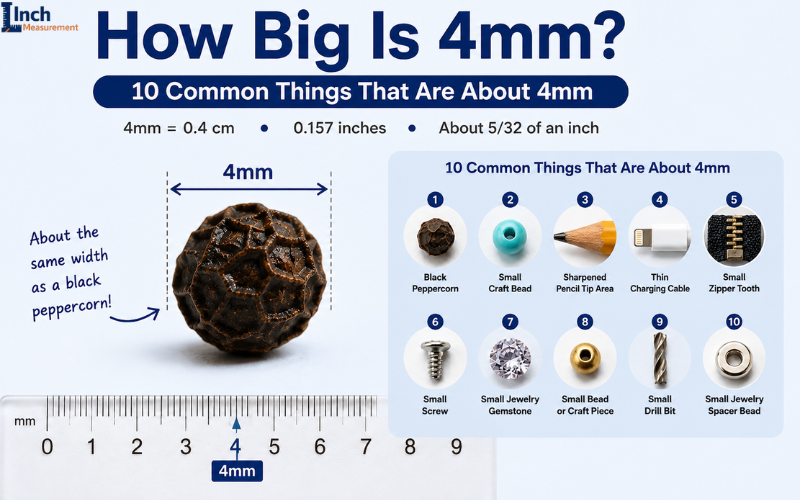
4mm is a very small measurement. It equals 0.4 centimeters, about 0.157 inches, or roughly 5/32 of an inch. If you are trying to picture 4mm without a ruler, think of a small peppercorn, a tiny craft bead, or another small object that is only a few millimeters across.
Four millimeters is small enough to be used for jewelry, beads, screws, wires, drill bits, and other small parts. It is also a size you may come across when shopping online. A product listed as 4mm can look larger in a close-up photo than it really is, so having a familiar object for comparison can be helpful.
The easiest way to understand 4mm is to see it as a real-world size rather than just a number. In this guide, you will find common examples that are close to 4mm, along with simple ways to estimate the size when you do not have a ruler nearby.
4mm in Inches, Centimeters, and Other Measurements
Here are the most useful conversions for 4mm: For everyday use, the easiest numbers to remember are 4mm = 0.4cm and 4mm ≈ 0.16 inches.
The fraction 5/32 inch is also very close to 4mm. Five thirty-seconds of an inch is about 3.97mm, so it is a useful reference when working with inch-based measurements
What Does 4mm Look Like?
A 4mm measurement is much smaller than one inch. To put it into perspective, one inch is 25.4mm, so 4mm is only a small part of an inch.
A round object that is about 4mm wide would fit easily on the tip of your finger. You can see it without a magnifying glass, but small details may be difficult to judge accurately by eye.
This is why 4mm can be tricky when shopping online. A photo of a 4mm bead or gemstone may be enlarged on the screen, making it appear much bigger than it is in real life.
For small products, always check whether the listed 4mm measurement refers to diameter, thickness, width, or length. These are not interchangeable. For example, a 4mm bead usually refers to its diameter, while a 4mm cable measurement may refer to its outside thickness.
8 Common Things That Are About 4mm
The examples below are useful for getting a visual idea of 4mm. They are approximate comparisons, not fixed standards. Natural and manufactured objects vary in size, so use them to understand the scale rather than as a substitute for an exact measurement.
| # | Common Item | Approximate 4mm Comparison |
| 1 | Black Peppercorn | About 4mm across |
| 2 | Small Craft Bead | About 4mm diameter |
| 3 | Sharpened Pencil Tip Area | Can be in the few-mm range |
| 4 | Thin Charging Cable | Some cables are around 4mm thick |
| 5 | Small Zipper Tooth | Some small zipper teeth are around this size |
| 6 | Small Screw | Some small screws have a 4mm diameter |
| 7 | Small Jewelry Gemstone | 4mm stones are common in jewelry |
| 8 | Small Bead or Craft Piece | 4mm sizes are common in craft supplies |
| 9 | Small Drill Bit | 4mm diameter |
| 10 | Small Jewelry Spacer Bead | About 4mm diameter |
1. Black Peppercorn
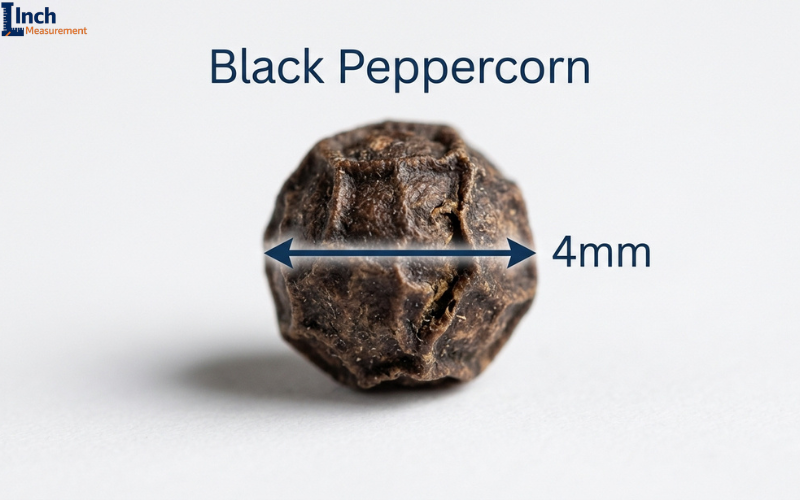
A black peppercorn is one of the easiest household objects to use when trying to picture 4mm. A typical peppercorn is small, round, and only a few millimeters across, although individual peppercorns can vary in size.
Its round shape makes it particularly useful as a comparison. When you look at a peppercorn on your fingertip, you can see that 4mm is small but not invisible. It is large enough to notice clearly while still being much smaller than most everyday objects.
This comparison is useful when shopping for small beads, jewelry stones, screws, or craft parts. If a product is described as 4mm in diameter, imagining a small peppercorn can give you a quick starting point.
For an exact measurement, however, do not assume every peppercorn is exactly 4mm. Natural foods are not manufactured to precise millimeter sizes.
2. Small Craft Bead
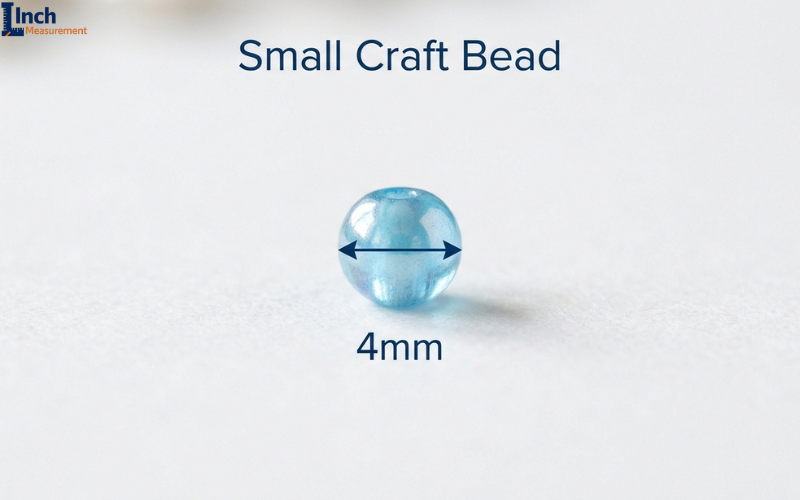
A 4mm craft bead is a more precise example because beads are commonly sold by their diameter. Small round beads used for bracelets, necklaces, and other crafts are often available in 4mm sizes.
A 4mm bead is tiny when held between your fingers. It is easy to handle, but it does not take up much space. If you line several beads next to each other, the difference between 4mm and larger bead sizes becomes easier to notice.
This is especially useful if you are buying beads online. A product photo can make a small bead appear large because the camera is close to it. Checking the listed diameter before ordering can prevent surprises.
If a seller says a bead is 4mm, look for the word diameter. That tells you the distance across the round bead, not the distance around it.
Related Post: 9 Common Things That Are 3mm Big
3. Sharpened Pencil Tip Area
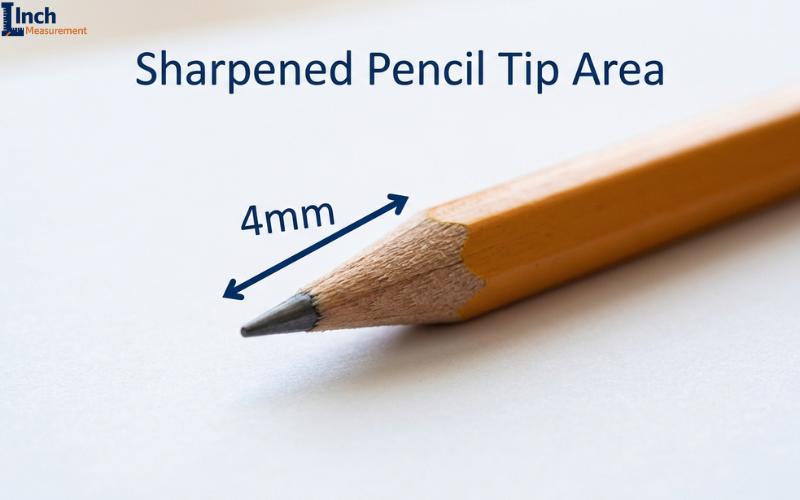
A sharpened wooden pencil gives you another familiar way to think about a measurement in the few-millimeter range. The exact width of the sharpened section changes depending on how the pencil is sharpened, so it should be treated as a visual reference rather than an exact 4mm measurement.
A pencil is useful because most people have seen one up close. The exposed wood and graphite point show just how small a few millimeters can be.
Keep in mind that the graphite point itself is much narrower than 4mm. The useful comparison here is the small area around the sharpened tip, not the thin graphite line.
For an exact 4mm measurement, use a ruler with millimeter markings rather than relying on the pencil.
4. Thin Charging Cable
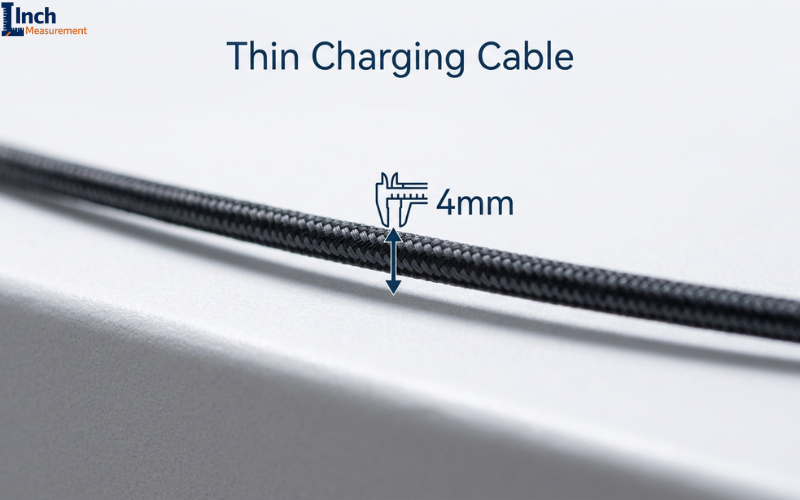
Some thin charging and electronic cables can have an outside diameter close to 4mm, but cable thickness varies considerably between brands and cable types.
A cable is a useful comparison because you can easily hold it between your fingers and see how a few millimeters feels in real life. It also shows why millimeter measurements matter in electronics. A small change in cable size can affect flexibility, protective covering, and the amount of material used around the internal wires.
Do not assume every phone or charging cable is 4mm thick. Some are noticeably thinner, while reinforced or braided cables can be much thicker.
If you are buying a replacement cable, check the manufacturer’s listed dimensions instead of using another cable as an exact reference.
5. Small Zipper Tooth
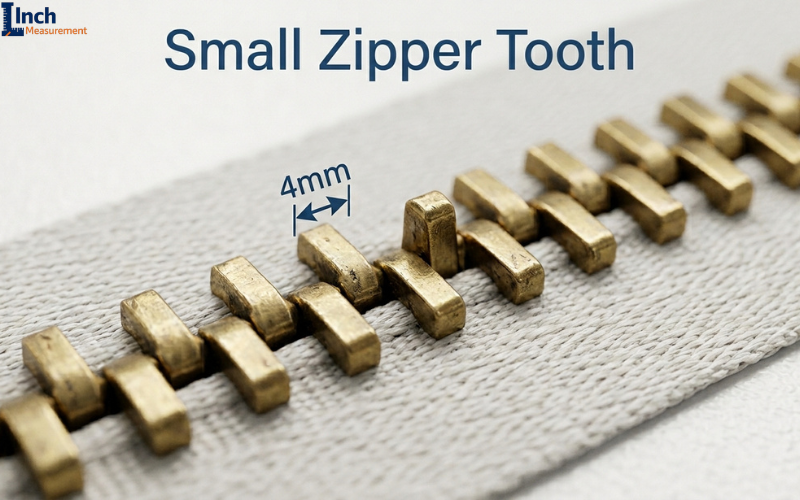
A small zipper tooth can give you a useful visual idea of how small 4mm is. Zipper teeth are designed to be compact while still connecting securely when the zipper is opened and closed.
The exact size depends on the zipper type. A small zipper on a pencil case may look very different from the larger teeth found on luggage or outdoor clothing.
The useful part of this comparison is the scale. A single zipper tooth is a tiny manufactured component, yet it has enough size and shape to be seen clearly. That helps explain why millimeters are commonly used for small mechanical and clothing parts.
If you are replacing a zipper, do not choose one simply because its teeth look close to 4mm. Zipper size and tooth type both matter for proper fit.
Related Post: 8 Common Things That Are 5mm Big
6. Small Screw
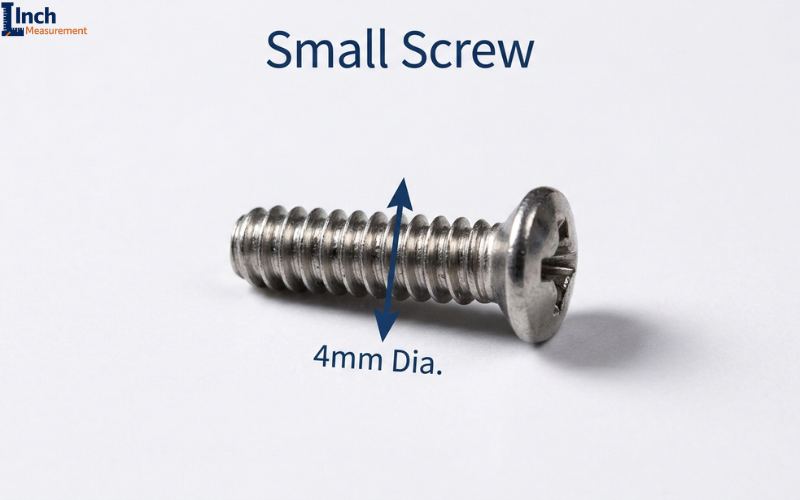
Some small screws have a diameter close to 4mm, particularly screws used in furniture, equipment, electronics, and other small assemblies. However, screw measurements can be confusing because a screw has several dimensions, including diameter and length.
For example, a screw could have a 4mm diameter but be 10mm, 20mm, or much longer. The 4mm measurement refers to the width across the threaded part, not the full length of the screw.
This makes screws a good example of why it is important to read product measurements carefully. If you are ordering hardware online, look for the complete size specification rather than focusing on one number.
A 4mm screw is small enough for compact projects but large enough to handle without being extremely difficult to see or work with.
7. Small Jewelry Gemstone
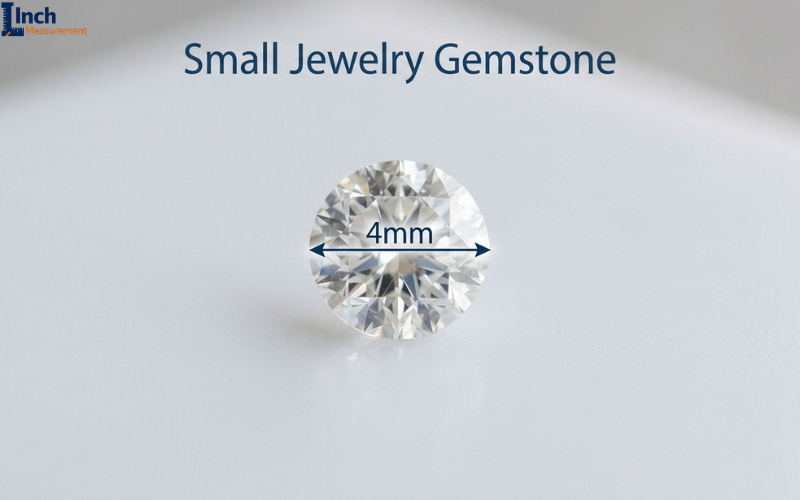
A 4mm gemstone is a common small size for jewelry. You may see this measurement used for stones in earrings, rings, bracelets, and other pieces.
A round 4mm stone is small but still noticeable when worn. In a close-up jewelry photograph, however, it can appear much larger than it will look on your hand or ear. This is one reason size measurements are important when shopping online.
When a jewelry listing says a stone is 4mm, check whether the measurement refers to the stone’s diameter. A round 4mm stone is about 4mm from one edge to the opposite edge.
If you want a subtle piece of jewelry rather than a large statement stone, seeing a real 4mm reference can help you choose with more confidence.
8. Small Bead or Craft Piece
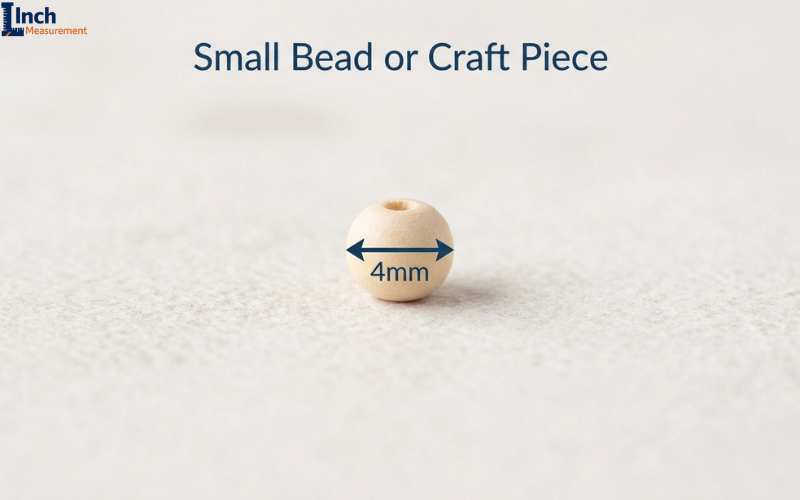
Small beads and craft pieces are often measured in millimeters, making them another useful reference for 4mm. A 4mm bead is small enough for detailed jewelry and craft projects while still being easy to handle with your fingers.
Craft stores and online sellers may offer beads in several sizes, such as 3mm, 4mm, 6mm, and 8mm. The difference can seem minor when you only see the numbers, but the size becomes much easier to notice when the beads are placed beside one another.
If you are buying craft supplies, pay attention to whether the measurement is the bead’s diameter or another dimension. A 4mm round bead means roughly 4mm across.
This makes craft beads one of the better real-world examples for understanding exactly how small 4mm can look.
See Also: 8 Common Things That Are 6mm Big
9. Small Drill Bit
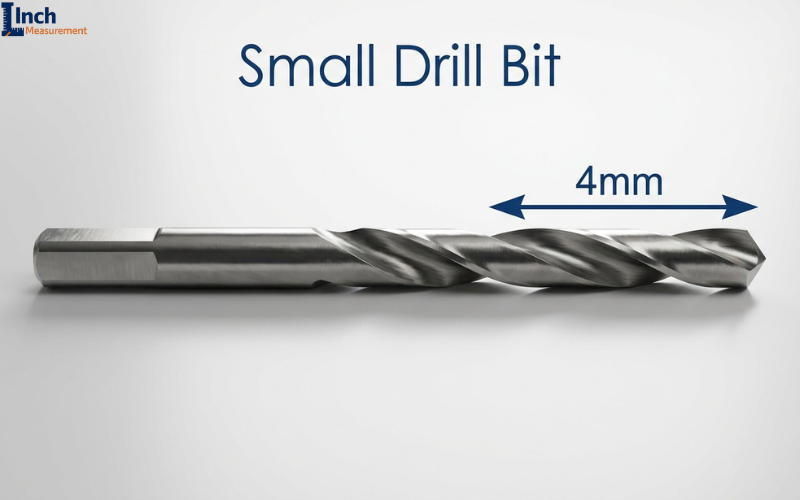
A 4mm drill bit is a useful exact example because drill bits are commonly measured by their diameter. A 4mm drill bit has a cutting end that is 4 millimeters wide, making it a good way to picture just how small this measurement is.
A drill bit this size is often used for making small holes in wood, plastic, and some types of metal, depending on the bit and the job. When you hold one between your fingers, it looks thin compared with larger household tools.
This example is also helpful because the measurement has a clear meaning: 4mm refers to the diameter of the bit, not its total length. A 4mm drill bit can be several inches long while still having a 4mm cutting diameter.
10. Small Jewelry Spacer Bead
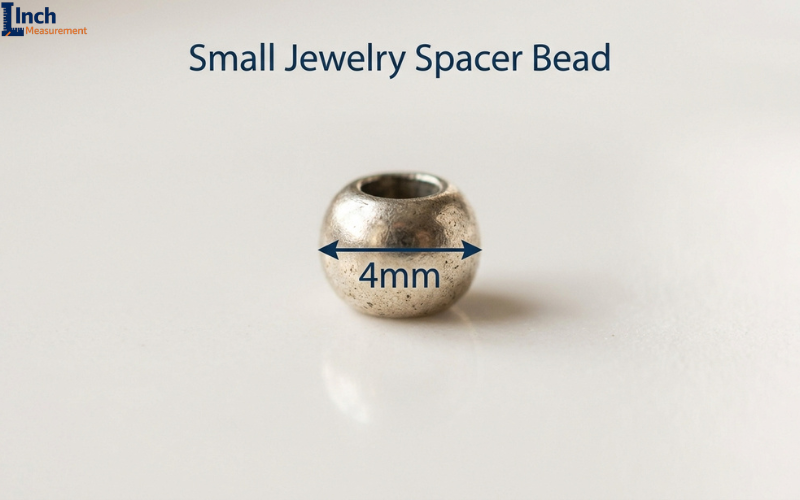
A 4mm jewelry spacer bead is another simple way to understand this tiny measurement. These small beads are used between larger beads in bracelets, necklaces, and other jewelry designs. A round spacer bead measuring 4mm is about 4mm across.
Because jewelry beads are sold in different sizes, placing a 4mm bead beside a 6mm or 8mm bead makes the difference easy to see. Even a few millimeters can noticeably change the look of a finished bracelet or necklace.
A 4mm bead is small enough to fit several pieces across a short section of jewelry, yet it is still large enough to handle with your fingers. If you are buying beads online, check whether the listed 4mm measurement refers to the diameter, since bead sizes can be described in different ways.
How to Estimate 4mm Without a Ruler
You can make a rough estimate of 4mm using familiar objects, but these methods should not be used when accuracy matters.
Compare It With a Small Bead
If you have a craft bead that is labeled 4mm, it can become your own reusable reference. Keep it beside your craft supplies or workspace and compare other small objects against it.
Use a Peppercorn
A small peppercorn can give you a quick visual estimate because its diameter is in the same general range. Remember that peppercorns vary, so this is only an approximation.
Compare With a Thin Object
A thin cable, zipper component, or similar small part can help you judge the scale. This is useful when you only need to know whether something is roughly 4mm rather than exactly 4mm.
Use a Millimeter Ruler for Accuracy
If the measurement actually matters, skip the guesswork. A ruler with millimeter markings is much more reliable. Place the object against the zero mark and check where its edge ends.
For round objects, measure straight across the center to get the diameter. Measuring around the outside gives you the circumference, which is a different measurement.
Common Mistakes When Measuring 4mm
Small measurements are easy to get wrong, especially when the object is curved or photographed close up.
Do not confuse diameter with circumference. A 4mm bead means 4mm across if the listing gives its diameter. It does not mean the distance around the bead is 4mm.
Do not trust a photo for scale. A close-up image can make a tiny 4mm object look much larger than it really is.
Check the unit before buying. 4mm is not the same as 4cm. Four centimeters is ten times longer than 4mm.
Check which dimension is being measured. For a screw, cable, box, or piece of jewelry, the listed measurement may refer to width, thickness, length, or diameter.
Use an actual measuring tool when fit matters. If you are buying replacement hardware, drilling a hole, sizing jewelry, or checking whether a part will fit, a visual estimate is not precise enough.
Where Is 4mm Used?
A 4mm measurement appears in many small products and parts. You may come across it when looking at:
- Jewelry stones and beads
- Craft supplies
- Small screws and hardware
- Wires and cables
- Drill bits
- Zipper components
- Electronic parts
- Small decorative pieces
The reason millimeters are useful for these products is simple: inches can be too large a unit for describing very small differences. A change of just 1mm can be noticeable when working with jewelry, hardware, or small mechanical parts.
4mm at a Glance
If you only need the quick answer, remember these three points:
- 4mm = 0.4cm
- 4mm ≈ 0.1575 inches
- 4mm ≈ 5/32 inch
For a visual reference, think of a small craft bead or peppercorn. For an exact measurement, use a ruler marked in millimeters.
More Related Measurements Guide:
- 9 Common Things That Are 2mm Big
- 9 Common Things That Are 1mm Big
- 10 Common Things That Are 10cm
- 9 Common Things That Are 5cm Big
- 9 Common Things That Are 3CM Big
Frequently Asked Questions
Is 4mm very small?
Yes. 4mm is less than one-fifth of an inch, so it is a small measurement. It is commonly used for beads, jewelry, screws, cables, and other small parts.
How many inches is 4mm?
4mm is approximately 0.1575 inches. It is also very close to 5/32 of an inch.
What does 4mm look like?
A small 4mm craft bead or a peppercorn can give you a useful visual idea. Keep in mind that natural objects vary, so they should only be used for comparison.
What is 4mm used for?
You may see 4mm used to describe the diameter of beads and gemstones, the size of small hardware, or the thickness of certain cables and other small components.
Is 4mm the same as 4cm?
No. 4mm equals 0.4cm, while 4cm equals 40mm. Confusing these two units would make an object appear ten times larger than it really is.
Can I measure 4mm without a ruler?
You can estimate it using a small bead, peppercorn, or another familiar object, but these methods are not exact. If the measurement affects whether a part will fit, use a millimeter ruler or caliper.
Conclusion
4mm is a small measurement equal to 0.4cm, about 0.1575 inches, or roughly 5/32 inch. It can be difficult to picture from the number alone, which is why real-world comparisons are useful.
A small craft bead, peppercorn, jewelry stone, zipper component, or small screw can help you understand the scale. Just remember that these objects vary, so they are best used as visual references rather than exact measuring tools.
If you are buying a small product online, pay close attention to what the 4mm measurement describes. It could mean diameter, thickness, width, or another dimension. When the exact size matters, check the product’s specifications and confirm the measurement with a proper tool.
