
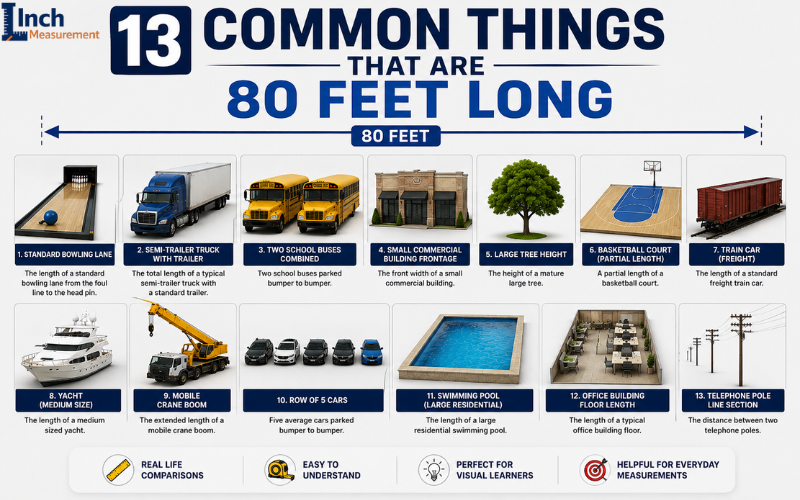
Have you ever wondered how long is 80 feet? While the number may sound simple, visualizing 80 feet without a measuring tape can be challenging. This length is equal to 960 inches (2,438.4 cm or 24.38 meters) and is commonly seen in sports facilities, construction sites, and large outdoor spaces.
The easiest way to understand 80 feet is by comparing it with familiar objects you see every day. In this guide, you’ll explore 13 common things that are about 80 feet long, learn simple ways to estimate this distance without a ruler, and discover practical examples that make this measurement easy to picture. Whether you’re measuring a property, planning a project, or satisfying your curiosity, these comparisons will help you visualize 80 feet with confidence.
How Long Is 80 Feet?
80 feet is equal to 960 inches, 26.67 yards, 24.38 meters, or 2,438.4 centimeters. It is roughly the length of four mid-size cars parked end to end, two city buses, or the height of a large mature tree. These everyday comparisons make it much easier to understand how long 80 feet is.
Whether you’re measuring a large backyard, planning a construction project, or estimating distance without a tape measure, knowing what 80 feet looks like can be very helpful. In the sections below, you’ll find 13 real-life examples of things that are about 80 feet long, along with practical comparisons that help you quickly visualize this impressive length.
How Long Is 80 Feet? (Quick Explanation)
An 80-foot length is considered quite large for everyday objects. To put it into perspective:
- It equals 960 inches
- About 26–27 average adult steps
- Nearly half the length of a soccer field
- Around the height of an 8-story building
This length is commonly seen in transportation, construction, and large-scale equipment. Visual comparisons make it easier to estimate or understand without needing a measuring tape.
How to Measure 80 Feet Without a Ruler
Estimating 80 feet without a measuring tape is simple when you use everyday references. These practical methods can help you visualize how long 80 feet is with reasonable accuracy.
Walk 32 Average Steps
An average adult step is about 2.5 feet long. By taking 32 normal steps, you can estimate a distance of approximately 80 feet.
Use Four Mid-Size Cars
A typical mid-size car is around 20 feet long. Parking four cars bumper to bumper creates a distance close to 80 feet, making it an easy visual comparison.
Compare It to Two City Buses
Most city buses are about 40 feet long. Imagine two buses parked end to end, and you’ll have a good estimate of 80 feet.
Measure 26⅔ Yards
Since 1 yard equals 3 feet, 26⅔ yards is exactly 80 feet. If you’re familiar with yard measurements, this is another quick way to estimate the distance.
Quick Comparison Table of 80 Feet Examples
| Item | Length (inches) |
| Standard Bowling Lane | 80 feet |
| Semi-Trailer Truck with Trailer | 80 feet |
| Two School Buses Combined | 80 feet |
| Small Commercial Building Frontage | 80 feet |
| Large Tree Height | 80 feet |
| Basketball Court (Partial Length) | 80 feet |
| Train Car (Freight) | 80 feet |
| Yacht (Medium Size) | 80 feet |
| Mobile Crane Boom | 80 feet |
| Row of 5 Cars | 80 feet |
| Swimming Pool (Large Residential) | 80 feet |
| Office Building Floor Length | 80 feet |
| Telephone Pole Line Section | 80 feet |
1. Standard Bowling Lane
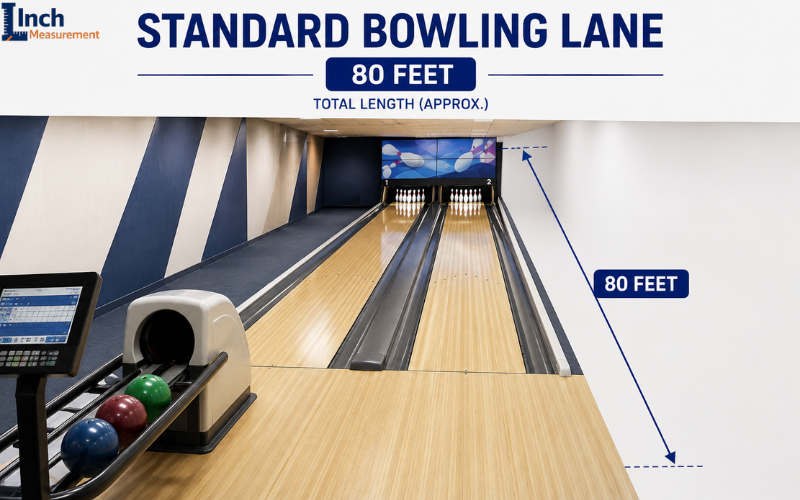
A standard bowling lane is one of the best real-life examples to help you understand how long 80 feet is. While the lane itself measures 60 feet from the foul line to the head pin, adding the approach area and the space behind the pins brings the total length to around 80 feet. This makes a bowling alley an excellent reference for visualizing this distance.
If you’ve ever been to a bowling center, you have already seen a space that is close to 80 feet long. Standing at the beginning of the approach and looking toward the back of the pin deck gives you a clear idea of how far 80 feet extends. It is much longer than it appears while playing, making it a memorable comparison.
Using a standard bowling lane as a reference is helpful because bowling alleys have consistent dimensions worldwide. Whether you’re estimating a large indoor space, planning a recreational area, or simply wondering what 80 feet looks like, imagining the full length of a bowling lane provides an easy and accurate way to picture this measurement
2. Semi-Trailer Truck with Trailer
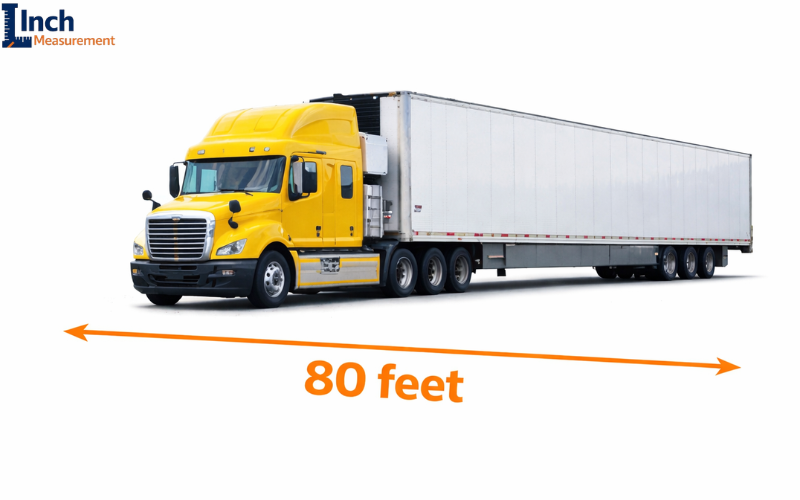
A semi-trailer truck with its trailer is another excellent way to visualize how long 80 feet is. While a standard tractor-trailer is often shorter, certain extended truck and trailer combinations used for transporting freight can measure close to 80 feet in total length. Seeing one on a highway gives you a realistic sense of this impressive distance.
If you’ve driven beside a large commercial truck, you’ve probably noticed how much road it occupies. An 80-foot semi-trailer stretches across a significant portion of the roadway, making it much easier to picture than simply thinking about the number. Its long frame is designed to carry heavy cargo while maintaining stability during transport.
This comparison is especially useful for understanding the size of loading docks, industrial sites, warehouses, and large parking areas. Instead of imagining 80 feet as an abstract measurement, think of a fully loaded semi-trailer truck extending nearly the length of several passenger cars. It’s a practical and memorable reference that helps you estimate 80 feet in everyday situations.
Related Post: How Long Is 70 feet
3. Two School Buses Combined
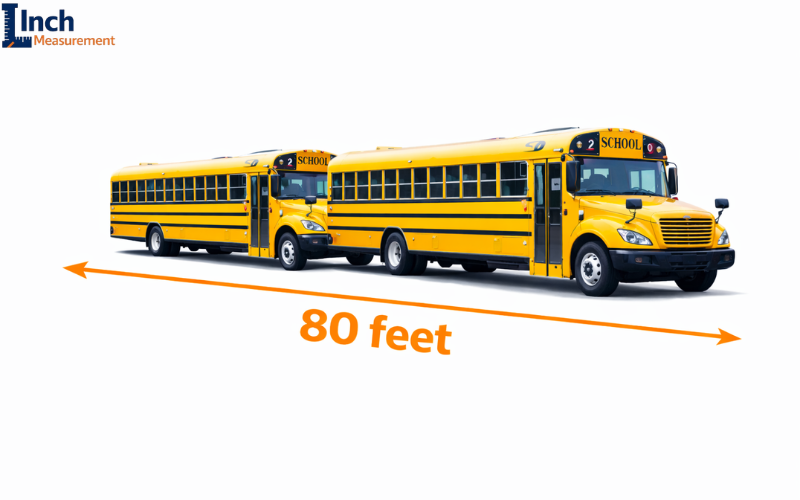
A pair of full-size school buses parked end to end is a simple and familiar way to understand how long 80 feet is. Since a typical school bus is about 40 feet long, placing two buses bumper to bumper creates a total length of approximately 80 feet. This makes them an excellent real-world comparison for visualizing this distance.
If you’ve ever seen school buses lined up outside a school or in a transportation yard, imagine standing at the front of the first bus and looking toward the back of the second. The combined length gives you a clear picture of 80 feet without needing a measuring tape. Because school buses are much longer than regular vehicles, this comparison helps highlight the scale of the measurement.
Using two school buses as a reference is helpful when estimating the length of parking lots, construction sites, sports facilities, or other large open spaces. Instead of thinking about numbers alone, picture two full-size buses parked in a straight line, and you’ll have a practical and easy-to-remember way to visualize 80 feet.
4. Small Commercial Building Frontage
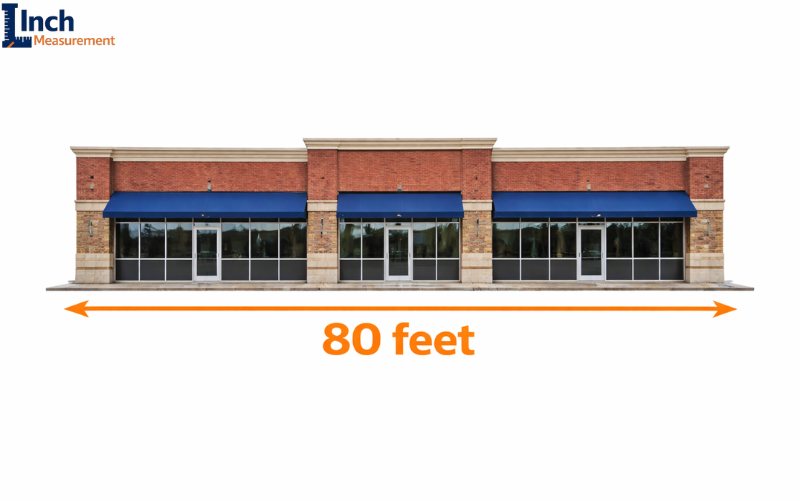
A small commercial building frontage is often around 80 feet wide, making it a practical example of how long 80 feet is. Many neighborhood stores, retail shops, restaurants, and office buildings are designed with frontages close to this size, depending on the property’s layout. This makes commercial buildings a useful reference for understanding large measurements.
If you’ve walked past a small shopping plaza or a standalone business, the distance from one end of the building to the other may be close to 80 feet. Looking across the entire front of the building provides a much clearer sense of this length than simply reading the number. It helps you appreciate how much space 80 feet actually covers.
Using a small commercial building frontage as a comparison is especially helpful because these buildings are common in cities and towns. Whether you’re estimating the width of a property, planning a construction project, or simply wondering what 80 feet looks like, imagining the front of a small commercial building offers a realistic and memorable way to visualize this distance.
5. Large Tree Height
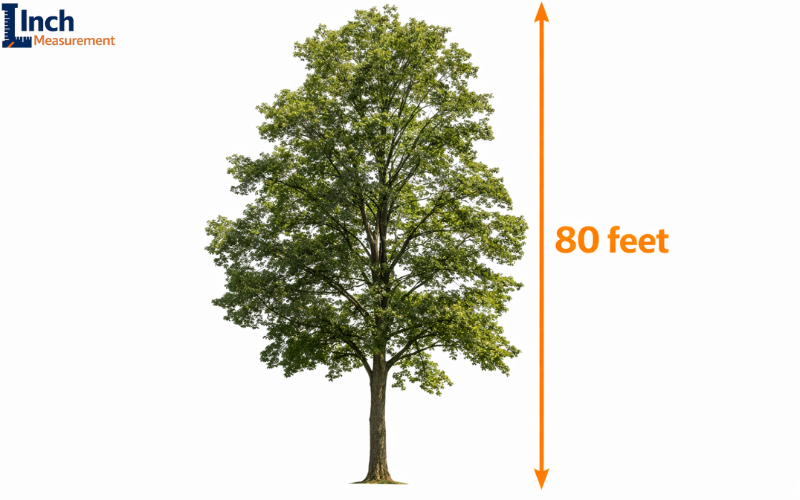
A large mature tree can grow to about 80 feet tall, making it one of the best natural examples of how long 80 feet is. Species such as pine, oak, sycamore, and maple can reach this height after many years of healthy growth. Standing next to a tree this tall gives you an impressive sense of the scale of 80 feet.
If you’ve visited a park, forest, or nature trail, you’ve probably seen trees towering high above nearby buildings and people. An 80-foot tree is roughly as tall as a seven- to eight-story building, making it much easier to imagine this measurement in everyday life. Looking from the base to the top of such a tree provides a clear visual reference for this height.
Using a large tree as a comparison is especially useful because trees are found almost everywhere. Whether you’re estimating the height of a tree, planning landscaping, or simply curious about what 80 feet looks like, picturing a fully grown 80-foot tree offers a simple, realistic, and memorable way to understand this distance.
6. Basketball Court (Partial Length)
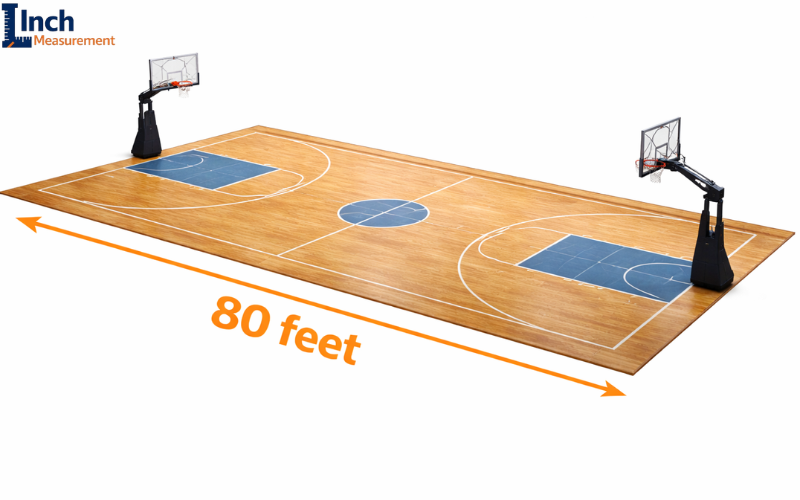
A basketball court is another easy way to picture how long 80 feet is. Although a standard NBA and college basketball court measures 94 feet in length, 80 feet covers most of the court, making it a close and practical comparison. If you’ve ever played or watched basketball, this familiar reference helps you quickly estimate the distance.
Imagine standing on one baseline and walking 80 feet toward the opposite end. You would be only a short distance away from the far baseline, giving you a realistic sense of how far 80 feet extends. Because basketball courts are found in schools, gyms, and recreation centers, they provide a convenient way to visualize this measurement.
Using a basketball court as a reference is especially helpful for estimating the size of indoor sports facilities, event spaces, or large open areas. Instead of thinking of 80 feet as just a number, picture nearly the entire length of a basketball court, and you’ll have a simple and memorable way to understand this distance.
7. Freight Train Car
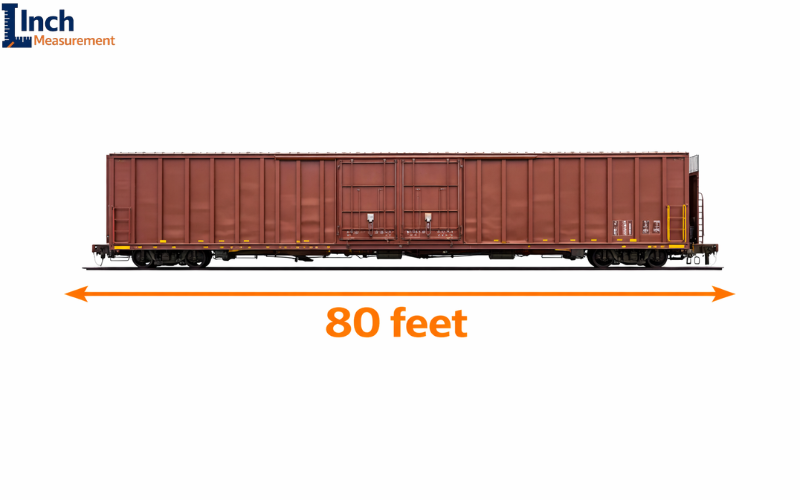
A freight train car is a practical example for understanding how long 80 feet is. Many modern freight and passenger railcars measure between 70 and 85 feet in length, so an 80-foot railcar provides a close real-world comparison. If you’ve seen a train passing through a station or railway crossing, you’ve likely observed a railcar that is about this long.
Standing next to an 80-foot freight train car shows just how much distance it covers. Its length is far greater than that of a typical passenger vehicle and is designed to transport large amounts of cargo efficiently. This makes it easier to visualize 80 feet than simply imagining the measurement.
Using a freight train car as a reference is helpful when estimating long distances in transportation, industrial areas, or construction projects. Whether you’re curious about how long 80 feet is or need a practical size comparison, picturing a single 80-foot train car offers a realistic and memorable way to understand this length.
8. Medium-Sized Yacht
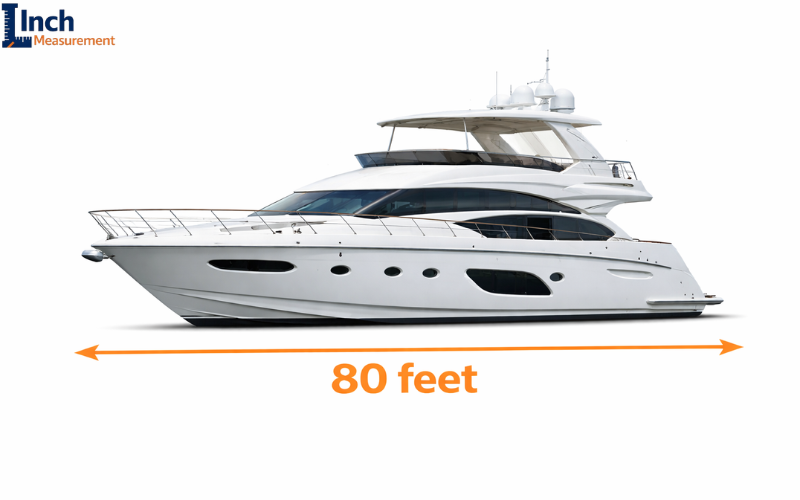
A medium-sized yacht can measure around 80 feet in length, making it an excellent example of how long 80 feet is. Many luxury motor yachts and sailing yachts are built in the 75- to 85-foot range, with 80 feet being a common size for private recreational vessels. Seeing one docked at a marina gives you a clear sense of this impressive length.
If you’ve visited a harbor or watched yachts on the water, imagine a vessel stretching from the bow to the stern for 80 feet. It is long enough to include multiple cabins, spacious decks, and entertainment areas, making it much larger than an ordinary boat. This real-world comparison helps you picture 80 feet more easily than numbers alone.
Using a medium-sized yacht as a reference is especially helpful because its length is easy to recognize in marinas and coastal areas. Whether you’re comparing large boats, estimating the size of a dock, or simply wondering what 80 feet looks like, an 80-foot yacht provides a realistic and memorable visual reference.
Related Post: 10 Common Things That Are 200 Inches Long
9. Mobile Crane Boom
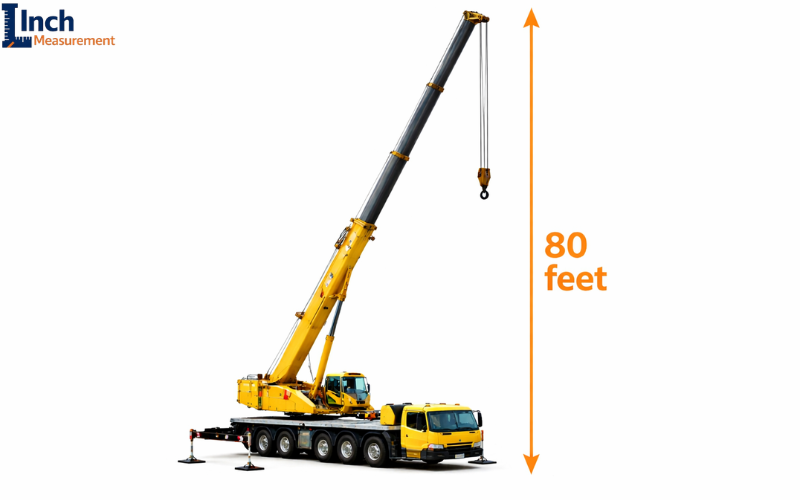
A mobile crane boom is a great example of how long 80 feet is. Many mobile cranes used on construction sites have booms that can extend to around 80 feet, allowing workers to lift heavy materials to upper floors or across large work areas. This makes cranes an excellent real-world reference for understanding this distance.
If you’ve seen a crane operating at a construction site, you’ve probably noticed how far its boom reaches when fully extended. An 80-foot crane boom can easily stretch over buildings, roads, or open spaces, giving you a clear idea of how much distance 80 feet covers. Its long reach makes the measurement much easier to visualize.
Using a mobile crane boom as a comparison is especially useful because cranes are designed with precise measurements. Whether you’re estimating the size of a construction project, planning equipment placement, or simply curious about what 80 feet looks like, picturing an 80-foot crane boom provides a practical and memorable reference.
10. Row of 5 Cars
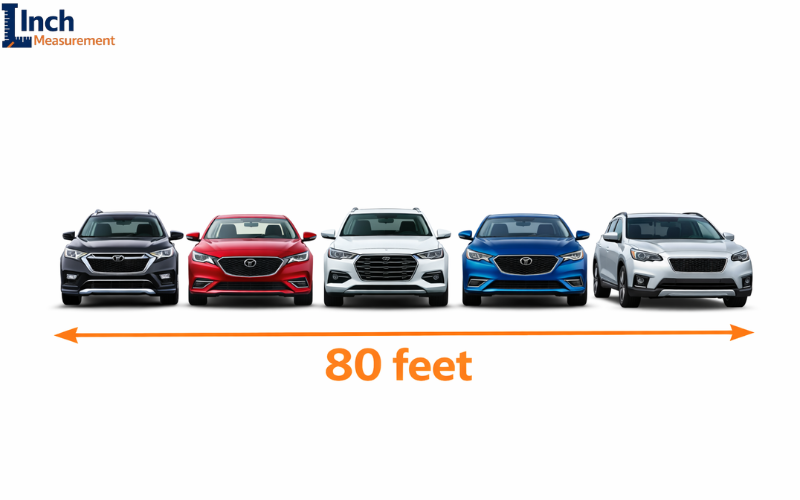
A row of five average-sized cars parked bumper to bumper is an easy way to visualize how long 80 feet is. Since a typical passenger car is around 16 feet long, lining up five cars creates a total length of approximately 80 feet. This everyday comparison makes it simple to picture the distance without using a measuring tape.
You’ve probably seen several cars parked in a straight line at a shopping center, office building, or parking lot. Imagine five family-sized cars with very little space between them, and you’ll have a close estimate of 80 feet. Because cars are familiar to almost everyone, this comparison is much easier to understand than numbers alone.
Using five parked cars as a reference is helpful when estimating the length of driveways, parking lots, construction sites, or other open spaces. Instead of trying to imagine 80 feet as an abstract measurement, think of five cars lined up end to end, and you’ll have a practical and memorable way to understand this distance.
11. Large Residential Swimming Pool
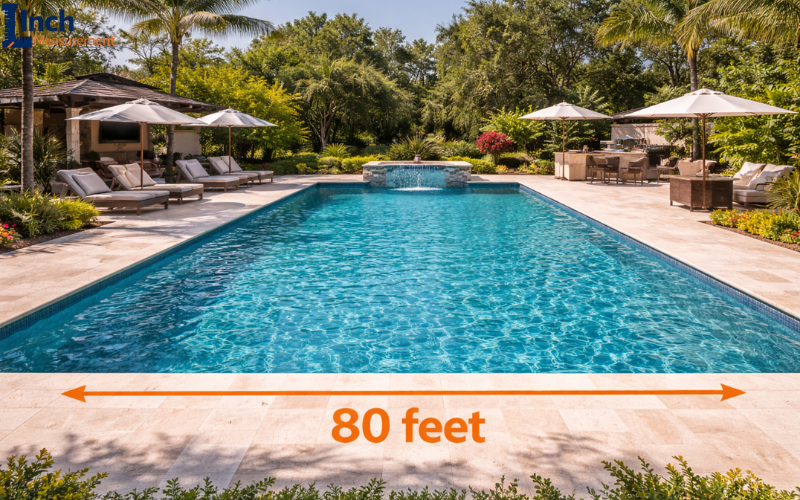
A large residential swimming pool can be about 80 feet long, making it a useful example of how long 80 feet is. While most backyard pools are much shorter, luxury homes, private estates, and training facilities sometimes feature pools that extend close to 80 feet. Seeing one in person provides a clear sense of this impressive distance.
If you’ve visited a large private residence, resort, or country club, you may have seen a swimming pool stretching across a spacious outdoor area. Walking from one end of an 80-foot pool to the other helps you appreciate how much space this measurement covers. Its length is ideal for exercise, lap swimming, and recreation, making it an easy comparison to remember.
Using a large residential swimming pool as a reference is especially helpful because it combines a familiar object with a measurable length. Whether you’re planning a backyard project, comparing outdoor spaces, or simply wondering what 80 feet looks like, picturing an 80-foot swimming pool offers a practical and memorable way to visualize this distance.
12. Office Building Floor Length
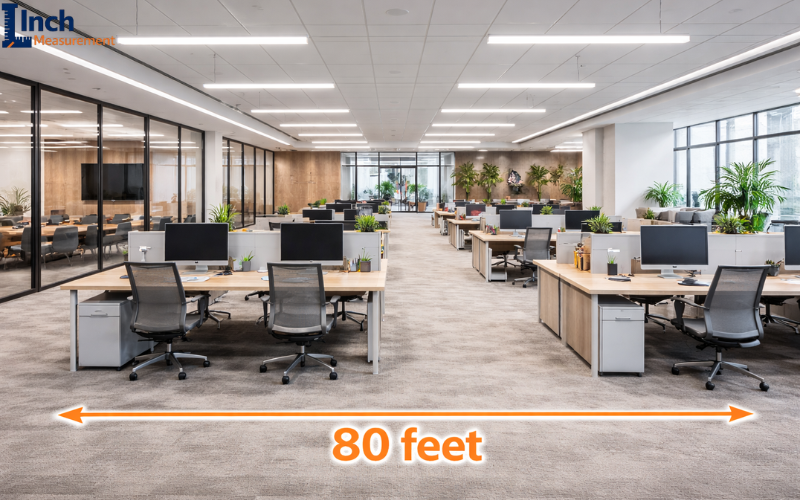
A section of an office building floor is often around 80 feet long, making it a practical example of how long 80 feet is. Many modern office buildings are designed with long open floor plans, where the distance from one end of a workspace to the other can measure close to 80 feet. This makes it an easy comparison for visualizing large indoor spaces.
If you’ve walked through a corporate office, business center, or coworking space, you’ve likely covered 80 feet without realizing it. From the entrance to the far end of an open office area, the distance can closely match this measurement. Because office floors are designed to maximize usable space, they provide a realistic reference for understanding 80 feet.
Using an office building floor as a comparison is especially helpful when estimating the size of commercial interiors, conference areas, or renovation projects. Rather than thinking of 80 feet as just a number, imagine walking across a long office workspace. It’s a familiar and memorable way to picture how long 80 feet is in everyday life.
Related post: 12 Common Things That Are 50 Inches Long
13. Telephone Pole Line Section
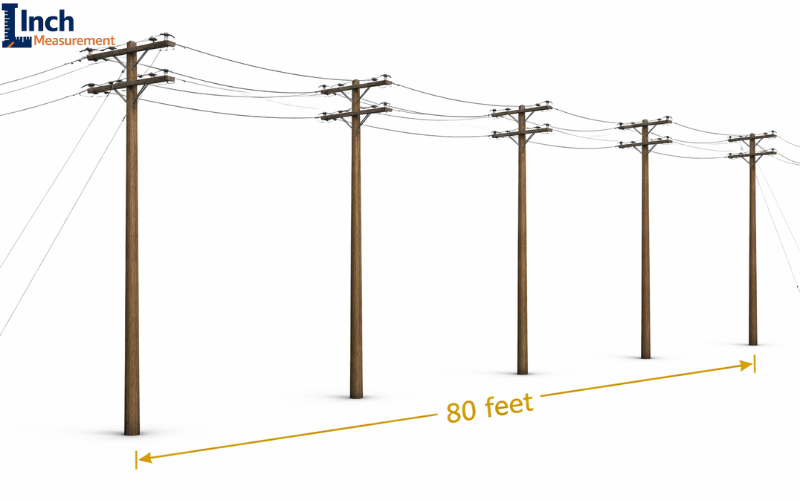
A section of telephone poles is a practical way to visualize how long 80 feet is. Utility poles are commonly spaced 80 to 150 feet apart, depending on the terrain, road layout, and the type of power or communication lines they support. In many neighborhoods, the distance between two nearby telephone poles is close to 80 feet, making it a familiar real-world comparison.
If you’ve walked along a residential street or country road, you’ve probably noticed telephone poles standing at regular intervals. Looking from one pole to the next can give you a good estimate of 80 feet without using a measuring tape. Since these poles are installed using standardized spacing, they provide a reliable reference for judging distance.
Using a telephone pole line section as a comparison is especially helpful because utility poles are found in cities, suburbs, and rural areas alike. Whether you’re estimating property boundaries, planning outdoor work, or simply wondering what 80 feet looks like, imagining the distance between two nearby telephone poles offers a simple and memorable way to understand this measurement.
If you found this guide helpful, explore more free measurement guides and real-life size comparisons below.
- 13 Common Things That Are 60 Feet Long
- 12 Common Things That Are 50 Feet Long
- 11 Common Things That Are 40 Feet Long
- 12 Common Things That Are 30 Feet Long
- 12 Common Things That Are 20 Feet Long
- 12 Common Things That Are 10 Feet Long
FAQs
How many inches are in 80 feet?
There are 960 inches in 80 feet. Since each foot equals 12 inches, multiplying 80 × 12 gives 960 inches.
What is an example of something that is 80 feet long?
Some common examples of 80 feet include two school buses parked end to end, a large residential swimming pool, an 80-foot mobile crane boom, or a freight train car.
How can I estimate 80 feet without a measuring tape?
You can estimate 80 feet by taking about 32 average walking steps, imagining five mid-size cars parked bumper to bumper, or comparing the distance to two school buses lined up end to end.
How long is 80 feet in meters?
80 feet is approximately 24.38 meters.
Is 80 feet considered long?
Yes, 80 feet is a large measurement, commonly used for buildings, vehicles, and industrial equipment.
What is comparable to 80 feet in sports?
It is slightly shorter than a full basketball court, which is 94 feet long.
Conclusion
So, how long is 80 feet? It is a little more than the length of a bowling lane and about the same as two school buses parked end-to-end. You can also picture five average cars lined up bumper to bumper, which makes 80 feet much easier to imagine.
For exact conversions, 80 feet equals 960 inches, 26.67 yards, or about 24.38 meters. Whether you are checking the size of a building, estimating a large outdoor space, or simply trying to picture the distance, these everyday examples give you a simple way to understand how far 80 feet really is.
