
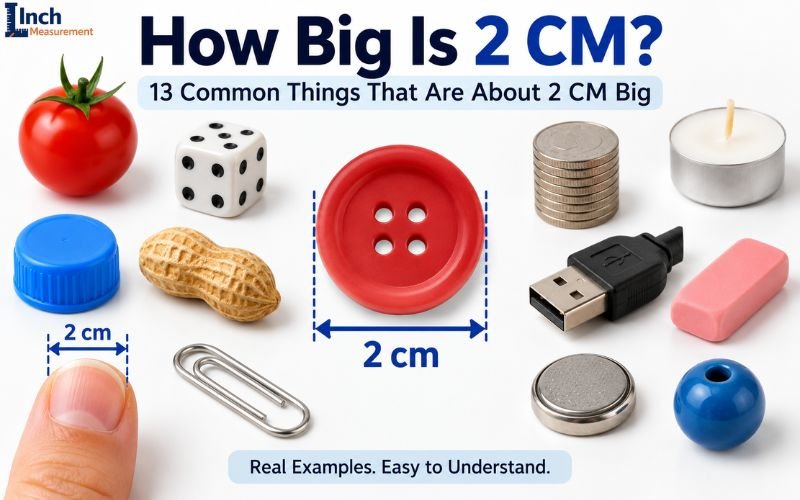
How big is 2 cm? 2 centimeters is equal to 0.79 inches or 20 millimeters. It is a small measurement that is just a little shorter than 1 inch. To picture it, think about the width of a small shirt button, a small dice, or part of your thumb.
Two centimeters may sound too small to visualize, but everyday objects make the measurement much easier to understand. You can find examples of this size in clothing, food, office supplies, household items, and small electronic parts.
How Big Is 2 CM?
Two centimeters is a short distance. Put another way, it is 20 mm, which is four-fifths of an inch. The exact inch conversion is approximately 0.7874 inches, usually rounded to 0.79 inches.
A useful way to picture it is to look at the first inch on a ruler. Two centimeters would stop just before the 1-inch mark. It is not a full inch, but the difference is small enough that the two measurements can look similar at a quick glance.
On a metric ruler, 2 cm covers the space from the 0 cm mark to the 2 cm mark. There are 10 small millimeter divisions in every centimeter, so you would count 20 mm from zero to reach 2 cm.
This size appears often in small household products. It can describe the diameter of a button, the width of a small object, the thickness of a part, or the length of a short piece of material. The direction being measured matters. Saying something is “2 cm” does not tell you whether that measurement refers to its length, width, height, diameter, or thickness.
For example, a round object measuring 2 cm across has a 2 cm diameter. A rectangular object could be 2 cm wide but much longer. This difference becomes especially useful when reading product dimensions online.
Where You May See a 2 CM Measurement
A 2 cm measurement can show up in many places. Clothing buttons, craft materials, small food items, bottle caps, and some electronic components can have dimensions close to this size.
It is also common to see 20 mm instead of 2 cm on product packaging. For example, a craft supplier might list a button as 20 mm, while another seller may describe a similar button as 2 cm. Knowing that these measurements are equal makes comparing products easier.
The measurement can refer to different parts of an object. A candle might have a 2 cm diameter but be 8 cm tall. A small box might be 2 cm wide but 5 cm long. Always check which dimension the measurement describes.
13 Common Things That Are About 2 CM Big
These 13 everyday objects give you a simple visual idea of what 2 cm looks like. Their exact sizes can vary, but each one is close enough to help you picture this small measurement without a ruler.
| Common Thing | Approximate Size |
|---|---|
| Small Shirt Button | About 2 cm diameter |
| Cherry Tomato | About 2 cm diameter |
| Small Game Dice | About 2 cm wide |
| Plastic Bottle Cap | Around 2 cm tall |
| Adult Thumb | About 2 cm wide |
| Peanut Shell | Around 2 cm long |
| Large Paper Clip | About 2 cm across |
| USB Connector | Around 2 cm wide |
| Small Candle | About 2 cm diameter |
| Stack of Coins | Around 2 cm high |
| Small Eraser | About 2 cm wide |
| Small Button Battery | About 2 cm diameter |
| Large Craft Bead | Around 2 cm diameter |
Small Shirt Button
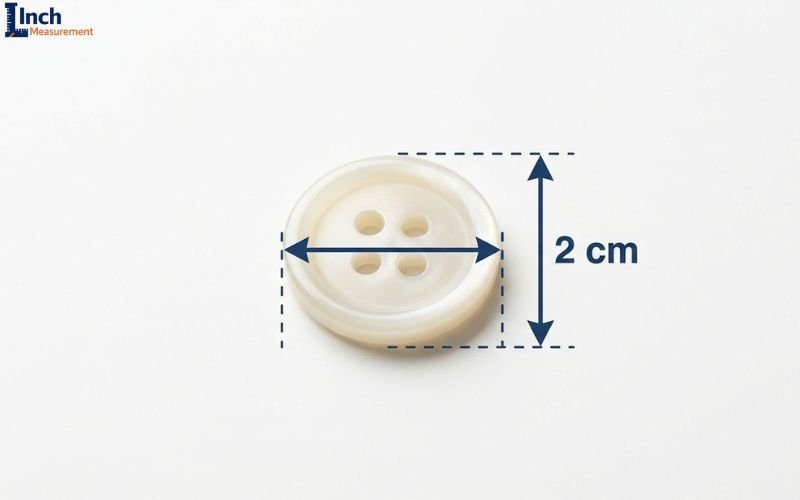
A small shirt button is one of the easiest ways to picture 2 cm. Many buttons used on shirts, jackets, sweaters, and other clothing are close to this size. A button with a diameter of 20 mm is exactly 2 cm across.
Look at the button from above and imagine a straight line running from one edge through the center to the opposite edge. If that line is 2 cm, the button has a 2 cm diameter.
Buttons are available in many sizes, though. Some shirt buttons are only 1 cm wide, while larger coat buttons can measure 2.5 cm or more. So a button should be treated as a comparison rather than an exact measuring tool.
This example is especially useful for sewing. If a pattern calls for a 20 mm button, you know that the button should be slightly smaller than a standard 1-inch button, which measures 25.4 mm.
Cherry Tomato
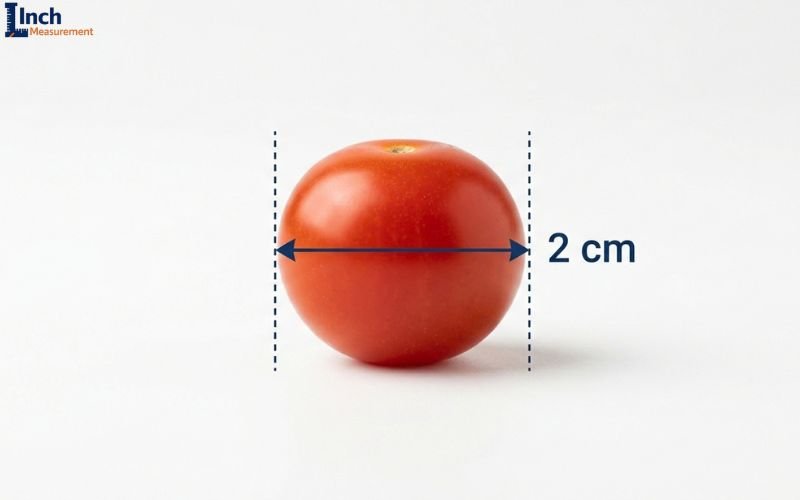
A small cherry tomato can be close to 2 cm in diameter. Its round shape makes it easy to compare with a 2 cm circle.
Not every cherry tomato is the same size. Some are smaller, while others can grow beyond 2 cm. If you have one that measures around 20 mm across its widest part, it gives you a useful physical example.
This comparison also helps explain the word diameter. The diameter is the straight-line distance across the center of a round object. It is not the distance around the outside.
For someone asking “what does 2 cm look like?”, a cherry tomato gives a familiar answer. You can hold it between your fingers and get a quick sense of the scale without having to imagine a number on a page.
Related Post: 12 Common Things That Are 1cm Big
Small Game Dice
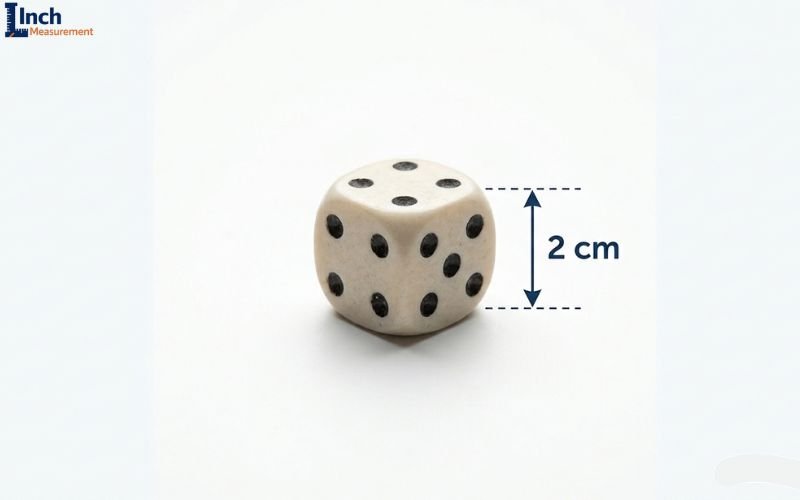
A small game die can measure around 2 cm on each side. A cube measuring 20 mm × 20 mm × 20 mm would have a side length of exactly 2 cm.
Dice are useful for visualizing this measurement because they have straight edges and a simple shape. If one side measures 2 cm, all three dimensions are approximately the same on a standard cube-shaped die.
Dice come in different sizes, so check the particular die before using it as a reference. Large tabletop dice can be considerably bigger than 2 cm.
A small die also shows how compact 2 cm really is. It can sit easily in your palm, yet its 2 cm sides are large enough to see and handle comfortably.
Plastic Bottle Cap
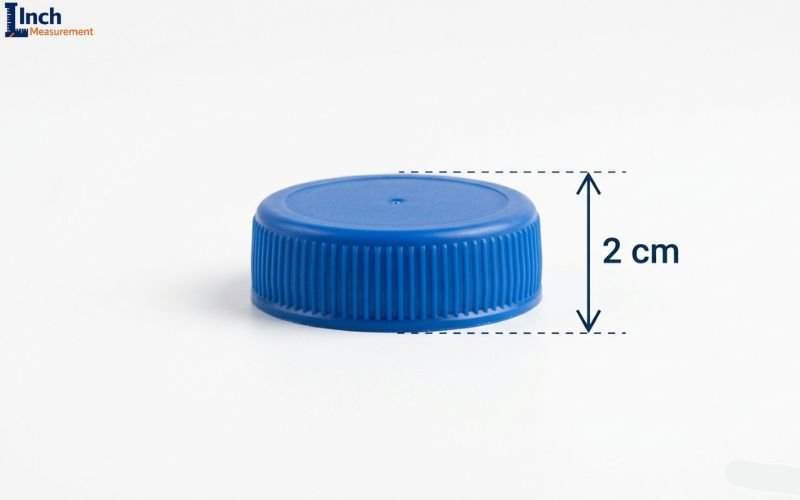
Some plastic bottle caps are close to 2 cm tall. This gives you another household object that can help you understand the measurement.
Bottle caps vary by brand and container. A water bottle cap may have different dimensions from a juice bottle or sports drink cap. Some are also wider than they are tall.
If the height of a particular cap is around 20 mm, it provides a reasonable 2 cm reference. Place it beside a ruler to check which part of the cap is actually close to the measurement.
This example is useful because it shows that “2 cm” can describe height. The cap might be wider than 2 cm while its vertical height is close to 2 cm.
Adult Thumb Width
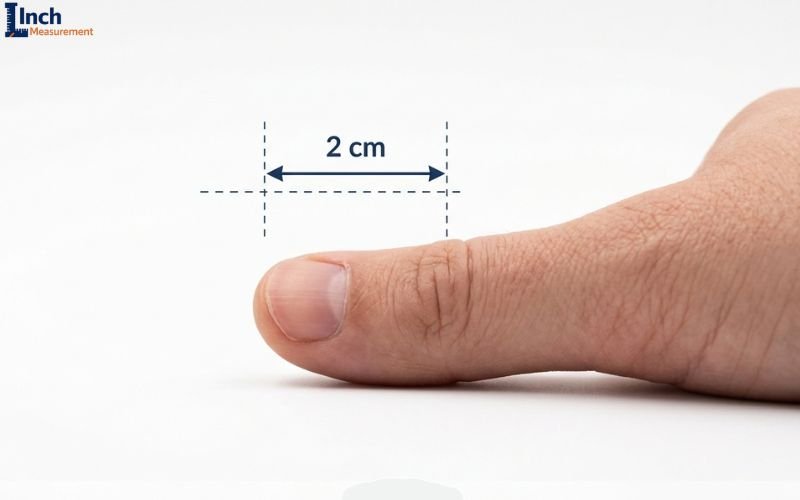
For many adults, the width of the thumb can be close to 2 cm. This makes your hand a convenient reference when you need a rough estimate and do not have a ruler.
Hold your thumb sideways and look at its widest section. If your thumb is around 20 mm wide, it can give you a quick visual idea of 2 cm.
This method is not precise because everyone’s hands are different. A child’s thumb, for example, may be much narrower, while some adults have thumbs wider than 2 cm.
Still, it can be useful while shopping, crafting, or checking the approximate size of a small object. For accurate work, use a measuring tool.
Peanut Shell
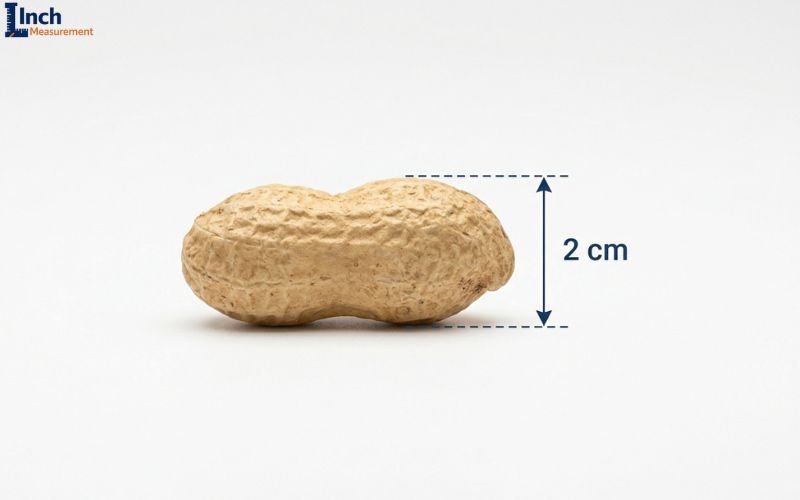
A small peanut shell can be around 2 cm in one dimension. Peanuts naturally vary in size, so this is another rough comparison rather than an exact standard.
The shell is small enough to hold between your fingertips, which makes it useful for understanding the scale of 2 cm. Looking at it next to a ruler also shows how a small object can have several different measurements.
For example, a peanut could be close to 2 cm across its shorter section but longer from end to end. This is why measurements of irregular objects should always specify what part is being measured.
Natural objects are useful for visual comparisons because they are familiar, but they should not be used when precision matters.
Related Post: 12 Common Things That Are 3CM Big
Large Paper Clip
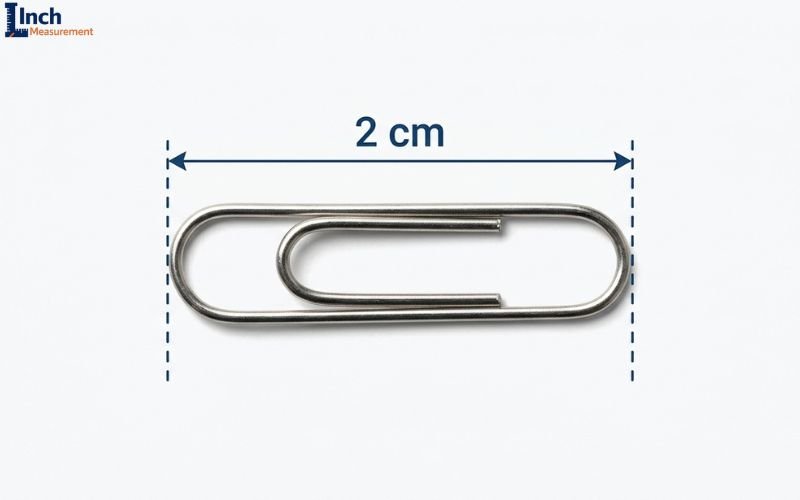
A large paper clip can help you visualize a measurement close to 2 cm across one of its shorter dimensions. Paper clips are common in offices, schools, and homes, making them convenient references.
The entire paper clip is usually longer than 2 cm. Its width or another smaller section may be closer to 20 mm.
This is a good example of why you should not describe an object with just one measurement. A paper clip has a length, width, and thickness, and each number can be different.
If you place a large paper clip next to a metric ruler, you can see how the 2 cm distance compares with its overall shape.
USB Connector
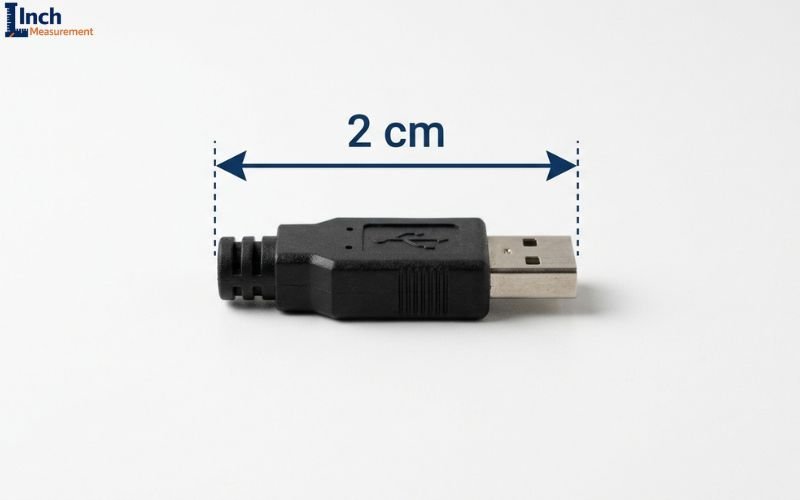
Some USB connectors are around 2 cm wide, depending on the connector type and the exact part being measured. USB-A connectors are a familiar example of a small electronic component with dimensions in this general range.
USB connectors come in several designs, including USB-A, USB-C, Micro-USB, and Mini-USB. They do not all have identical dimensions.
The reason this is a useful comparison is simple: most people have handled a USB cable. Its connector is small enough to fit in your hand but large enough that you can easily see the difference between a 2 cm section and a longer measurement.
For buying replacement cables or electronic parts, however, use the manufacturer’s stated dimensions. A visual comparison is not enough to guarantee that a connector will fit.
Small Candle
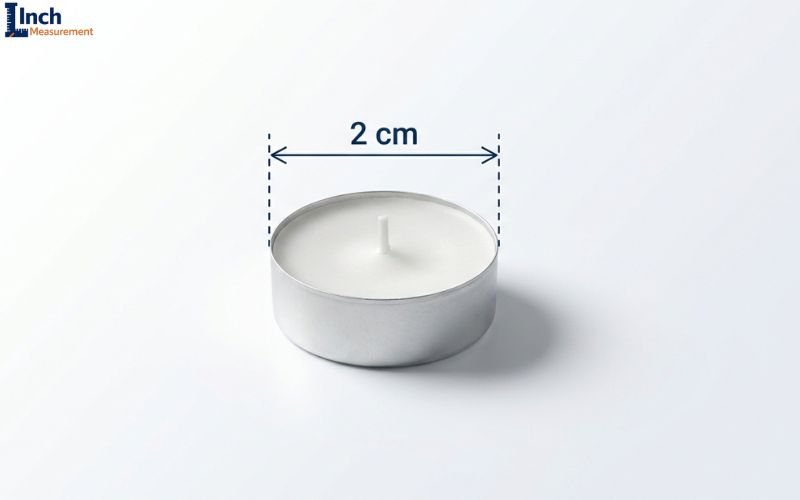
A small candle can have a diameter close to 2 cm. Narrow candles used for decorations, birthdays, crafts, or small holders may fall around this size.
Because a candle is usually round, its diameter is the easiest measurement to compare. Measure straight across the widest part rather than around the candle.
A candle that is 2 cm wide could still be several centimeters tall. For example, an 8 cm-tall candle with a 2 cm diameter would be much taller than it is wide.
This makes candles a helpful example of how different dimensions describe the same object. If you are buying a candle holder, the diameter is usually more important than the height for checking whether the candle will fit.
Stack of Coins
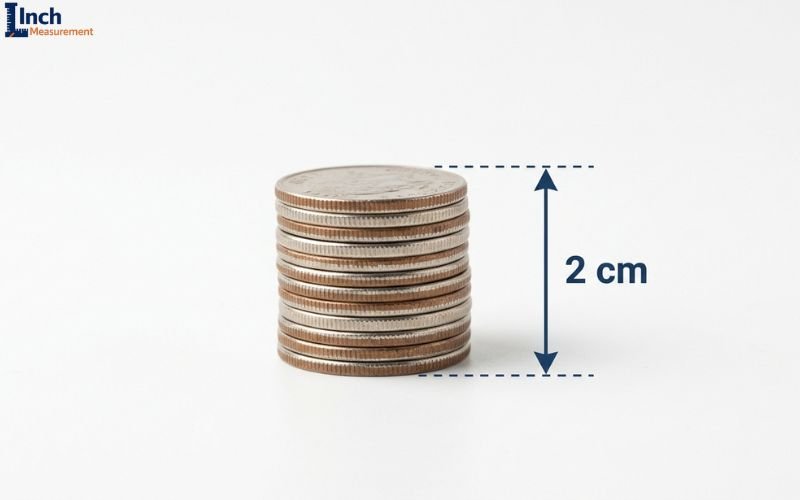
A short stack of coins can reach roughly 2 cm in height, depending on the type and thickness of the coins.
There is no fixed number of coins that always equals 2 cm because different coins have different thicknesses. A stack made from thick coins will reach 20 mm with fewer pieces than a stack made from thin coins.
This is still a useful way to picture the measurement because one thin coin may look very small. Several placed together create a height that is much easier to compare with a ruler.
If you need exactly 2 cm, measure the finished stack rather than counting coins and assuming they add up to the correct size.
Related Post: 12 Common Things That Are 5cm Big
Small Eraser
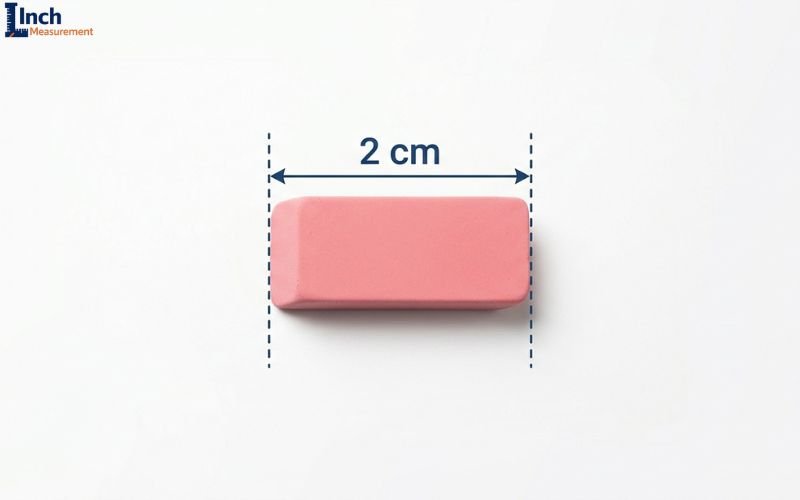
A small pencil eraser can be around 2 cm wide. Many compact erasers used by students and artists are close to this size, although their dimensions vary.
An eraser is particularly easy to compare because it normally has straight sides. Place it beside a ruler and check the width, length, and thickness separately.
For example, an eraser could be 2 cm wide, 4 cm long, and 1 cm thick. Calling the entire eraser “2 cm” would not give a complete picture.
Small stationery products are a common place to see centimeter measurements. If you are buying an eraser listed as 20 mm wide, you now know that the stated width is exactly 2 cm.
Small Button Battery
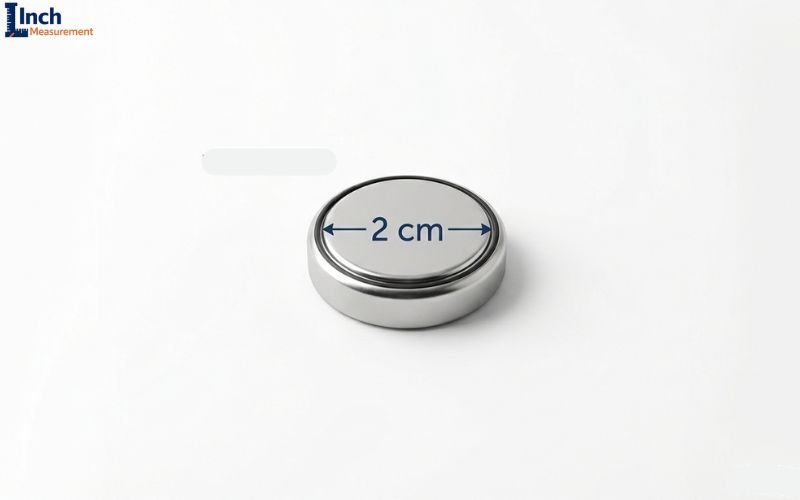
Some small button or coin-cell batteries can measure close to 2 cm across. Certain battery types have diameters around 20 mm, although battery dimensions depend on the specific model.
This is a good example of why exact product numbers matter. Button batteries are identified by specific codes, and two batteries that look similar can have different diameters and thicknesses.
If you are replacing a battery, never choose one simply because it appears to be about 2 cm wide. Check the device’s required battery number and specifications.
As a visual reference, though, a 20 mm battery provides a clear example of a circular object that is slightly less than 1 inch across.
Large Craft Bead
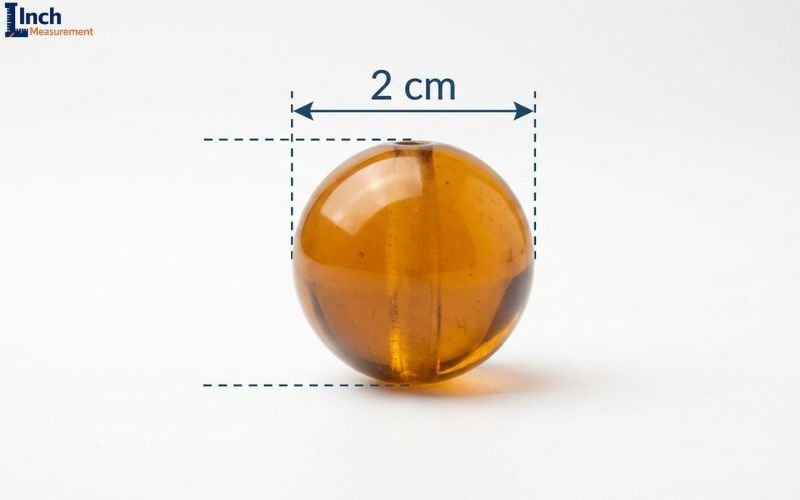
A large craft bead can be around 2 cm in diameter. Beads are sold in many different sizes, so a 20 mm bead is a specific size rather than a universal bead dimension.
A 2 cm bead is noticeably larger than the tiny beads often used for delicate jewelry. It is large enough to see clearly and can be used in decorative crafts, ornaments, and larger jewelry designs.
The hole through the center does not determine the bead’s overall diameter. If the bead is listed as 20 mm, that measurement normally refers to the outside diameter unless the product description says otherwise.
This makes a craft bead a useful example when shopping online for materials. Seeing “20 mm” in a product listing now gives you a much clearer idea of its physical size.
How to Measure 2 CM Without a Ruler
You can make a rough 2 cm estimate with a few everyday references. Your thumb width may be close, and a small button, bead, or dice can provide another visual comparison.
If you have a ruler available at some point, make a 2 cm mark on a piece of cardboard or paper. You can keep that reference for quick comparisons later.
A phone screen can also display a ruler, but screen measurements are not automatically accurate. Browser zoom and display settings can change the size shown on screen, so a digital ruler should be calibrated before you trust it.
For sewing, woodworking, crafts, electronics, or anything where a few millimeters matter, use a proper ruler or caliper.
Why 2 CM Can Look Different on Different Objects
The same 2 cm measurement can look very different depending on the shape of the object. A 2 cm circle, a 2 cm line, and a 2 cm cube all have the same relevant length, but they do not look alike.
The measurement’s direction also matters. A box may be 2 cm high but 10 cm long. A coin may have a 2 cm diameter while being only a few millimeters thick.
This becomes especially important when shopping online. Product dimensions might be written as 2 × 5 × 8 cm, which means the object has three separate dimensions rather than being simply “8 cm.”
Reading the complete dimensions prevents many size mistakes.
2 CM vs. 1 Inch
Two centimeters is slightly shorter than 1 inch.
2 cm = 0.7874 inches
1 inch = 2.54 cm
The difference is 5.4 mm. That may not sound like much, but it can matter when a part needs to fit into a specific space.
If you are familiar with a 1-inch object, picture a 2 cm line as slightly shorter. This is one of the easiest ways to remember the relationship.
2 CM vs. 2 Inches
Two centimeters and two inches are very different measurements.
2 cm = 0.79 inches
2 inches = 5.08 cm
Two inches is more than twice the length of 2 cm. Mixing these units up can cause problems when buying materials or following measurements.
For example, a 2 cm opening is quite small, while a 2-inch opening is more than twice as wide. Always check whether a product uses centimeters or inches before making a size comparison.
Related Measurements:
- 10 Common Things That Are 5 Meter Long
- 10 Common Things That Are 3 Meter Long
- 10 Common Things That Are 2 Meter Long
- 12 Common Things That Are 1 Meter Long
- 10 Common Things That Are 53 Inches Tall
FAQs
How big is 2 CM?
2 cm is 20 mm or about 0.79 inches. It is slightly shorter than 1 inch.
What does 2 CM look like?
It is roughly the width of some small buttons, beads, dice, and adult thumbs.
Is 2 CM the same as 20 mm?
Yes. 20 mm equals exactly 2 cm.
Is 2 CM smaller than 1 inch?
Yes. 2 cm is about 0.79 inches, so it is slightly smaller than 1 inch.
How can I measure 2 CM without a ruler?
You can make a rough estimate using your thumb, a small button, or another object close to 2 cm.
What is bigger: 2 CM or 2 inches?
2 inches is bigger. It equals 5.08 cm, while 2 cm equals only 0.79 inches.
Can a button be 2 CM?
Yes. Some small and medium clothing buttons have a diameter close to 2 cm.
How many millimeters are in 2 CM?
There are 20 millimeters in 2 centimeters.
Final Thoughts
2 cm is a small length equal to 20 mm or about 0.79 inches. It is just under 1 inch, which makes it fairly easy to picture once you compare it with familiar objects.
A small shirt button, cherry tomato, game die, bottle cap, thumb width, peanut shell, paper clip, USB connector, candle, coin stack, eraser, button battery, and craft bead can all help you develop a better sense of this size.
Remember that these objects are only references. Their actual dimensions can vary. When you need an exact 2 cm measurement, use a ruler, measuring tape, or another accurate measuring tool.
