
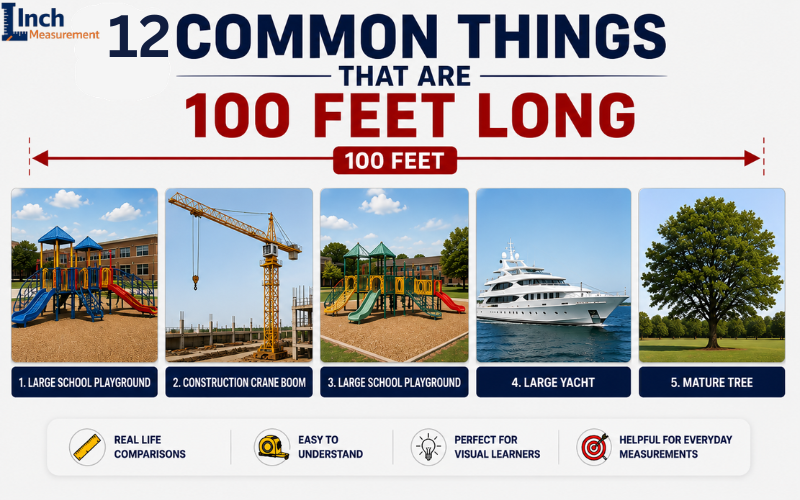
How long is 100 feet? It is a fairly long distance, but the number becomes much easier to understand when you compare it with things you see in everyday life. 100 feet equals 1,200 inches, 33.33 yards, 30.48 meters, or 3,048 centimeters. That means 100 feet is just over 30 meters from one end to the other.
To picture it, imagine a straight line across a large open space. You could fit several cars along it, or walk across it in a few dozen normal steps. A long driveway, large building frontage, or some outdoor spaces can also give you a useful idea of this distance.
In this guide, we will look at 12 common things that are about 100 feet long or close to it. Each example is chosen to make the measurement easier to picture rather than simply giving you another number. If you are planning a project, checking available space, or just curious about this length, these real-world comparisons will help you understand 100 feet in a simple and practical way.
What Does 100 Feet Look Like?
100 feet is a long distance, but it becomes much easier to picture when you compare it with familiar things. It is about the length of a large swimming pool, a long commercial building frontage, or several cars parked in a straight line. You can also think of it as 20 average adult steps of about 5 feet each, although walking stride varies from person to person.
Another simple way to picture 100 feet is to imagine a straight line across a large open space. From one end to the other, you would have enough room for several vehicles or a sizeable outdoor setup. Seeing the distance this way makes the number much easier to understand than simply reading “100 feet.”
How Can You Estimate 100 Feet Without a Tape Measure?
You do not always need a measuring tape to get a rough idea of 100 feet. Everyday objects and spaces can act as useful reference points.
- 10 cars parked end-to-end can give you a rough comparison.
- Two 50-foot sections placed together equal 100 feet.
- Walking around 20 long adult steps gives a rough estimate.
- A large open driveway or building frontage may be close to this distance.
- Marking points every 10 feet can help you divide the distance into smaller sections.
These methods will not replace an exact measurement, but they are handy when you only need a quick estimate. For construction, property work, or anything where accuracy matters, use a proper measuring tool.
Where Might You Come Across 100 Feet?
A 100-foot distance can appear in many places, especially around large properties, construction sites, sports areas, and transportation spaces. A long driveway may approach this length, while a large commercial property can have 100 feet or more along one side.
You may also come across 100 feet when planning an outdoor event, measuring a work area, setting up fencing, or checking the space available for vehicles. In sports and recreation, long fields and practice areas can also make a useful comparison.
The exact size of these places varies, so they should be treated as visual references rather than fixed 100-foot standards. Their main purpose is to help you develop a better sense of what 100 feet looks like in the real world.
Quick Comparison Table (100 Feet in Inches)
| Item | Length in Inches |
|---|---|
| Large Commercial Building Frontage | 100 Feet |
| Average Cars Parked End-to-End | 100 Feet |
| Construction Crane Boom | 100 Feet |
| Large School Playground | 100 Feet |
| Large Residential Driveway | 100 Feet |
| Three School Buses Parked End-to-End | 100 Feet |
| Large Shipping Container Setup | 100 Feet |
| Mature Tree Height | 100 Feet |
| Large Outdoor Event Space | 100 Feet |
| Small Commercial Parking Row | 100 Feet |
| Large Yacht | 100 Feet |
| Blue Whale | 100 Feet |
1. Large Commercial Building Frontage
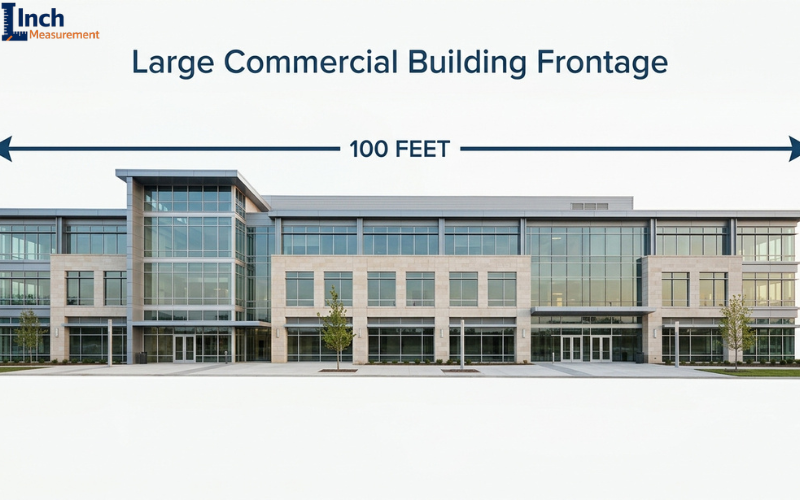
A large commercial building frontage can stretch about 100 feet from one end to the other. Think of the front of a shopping center, office building, or large retail store. A frontage this wide can have several entrances, windows, signs, and business spaces along it.
Building sizes are different, so 100 feet is only a useful comparison, not a fixed standard. Still, standing at one end and looking toward the other can give you a good idea of the distance.
This is a helpful example if you are trying to picture 100 feet across a property. Instead of imagining a number, you can picture walking along the entire front of a large commercial building.
2. 12 Average Cars Parked End-to-End
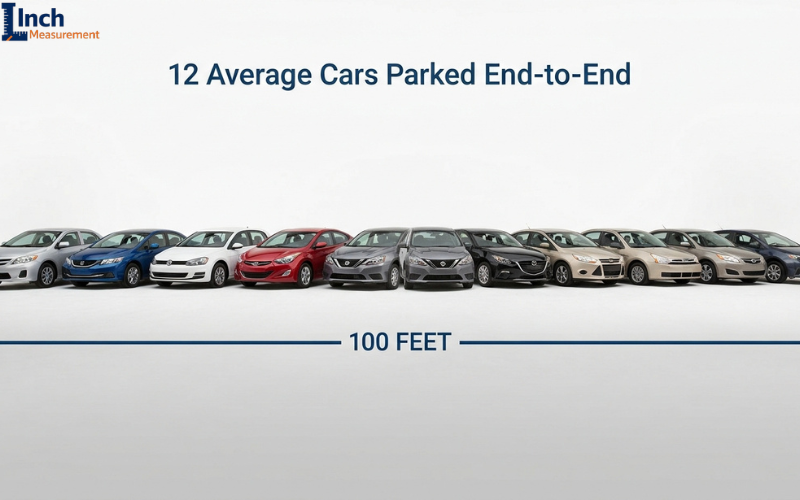
Imagine 12 average cars parked bumper-to-bumper in a straight line. Together, they can create a long row that gives you a useful visual idea of 100 feet, although the exact total depends on the size of each car.
Smaller cars will produce a shorter row, while larger vehicles will make the line longer. That is why this should be treated as an approximate comparison rather than an exact measurement.
Cars are an easy reference because most people see them every day. If you picture a long line of vehicles stretching across a parking area, you can get a much better sense of how far 100 feet really is.
Related post: How Long Is 90 feet
3. Construction Crane Boom
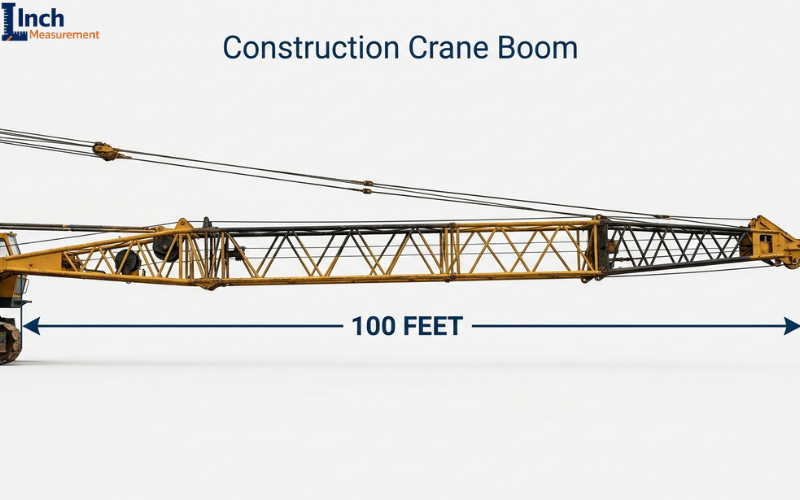
A large construction crane boom can reach around 100 feet or more, depending on the crane and the work being done. The boom is the long arm that extends from the crane and helps move heavy materials around a construction site.
Imagine the crane standing at one point while its long boom reaches far across the site. The distance from the base area toward the end of the boom can give you a useful picture of 100 feet.
Crane sizes vary, so not every crane will have a 100-foot boom. However, large cranes used for buildings, bridges, and industrial projects can make this measurement much easier to visualize.
4. Large School Playground
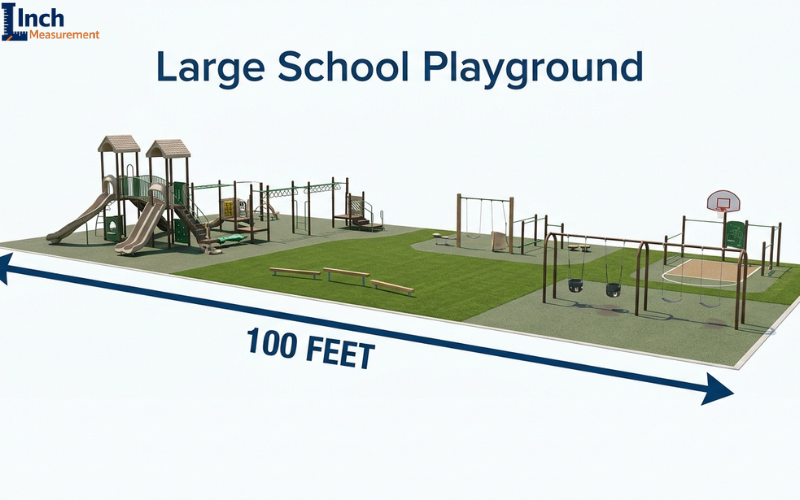
A large school playground can stretch about 100 feet from one end to the other. Picture a playground with swings, slides, climbing equipment, open space, and areas where students can run and play.
The actual size of a playground depends on the school and the available land. Some are much smaller, while others cover a large area. A playground close to 100 feet long gives you a simple real-world reference.
If you stand at one end and look toward the opposite side, the distance can help you understand what 100 feet looks like. It is much easier to picture than simply thinking about the number 100.
6. Three School Buses Parked End-to-End
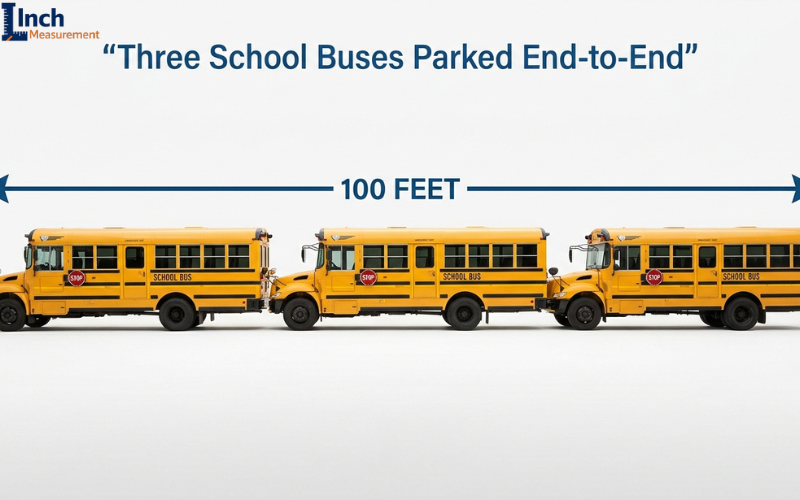
Picture three full-size school buses parked end-to-end in a straight line. Depending on the bus models, the combined length can be around 100 feet or slightly more.
Many full-size school buses are roughly 35 to 40 feet long. Putting three together creates a surprisingly long row and gives you a clear way to imagine a 100-foot distance.
School buses are familiar to most people, which makes this comparison easy to understand. Imagine standing beside the front of the first bus and looking all the way to the back of the third. That long stretch gives you a useful visual reference for 100 feet.
7. Large Shipping Container Setup
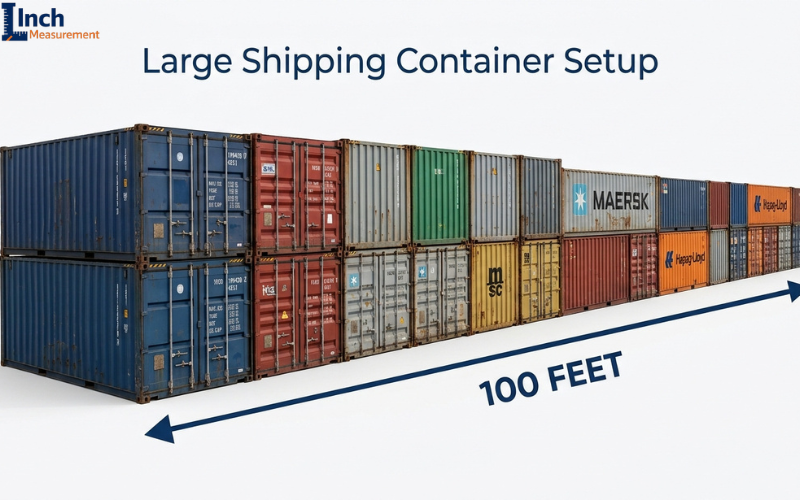
A large shipping container setup can cover close to 100 feet when several containers are placed together. Standard containers are commonly 20 or 40 feet long, so different combinations can create a total length near this measurement.
For example, placing two 40-foot containers together already gives you 80 feet. Adding another smaller section can bring the overall setup closer to 100 feet.
You can often see shipping containers at ports, warehouses, construction sites, and industrial yards. Imagine walking from the first end of a long container setup to the last. That can give you a practical idea of how much space 100 feet covers.
Related Post: 10 Common Things That Are 200 Feet Long
8. Mature Tree Height
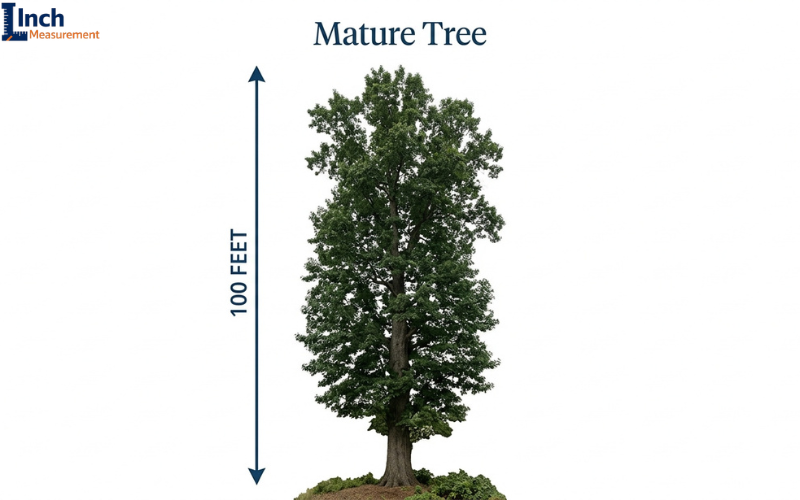
Some mature trees can reach around 100 feet tall, especially large species that grow for many years under good conditions. Tall pine, oak, and other forest trees can reach impressive heights.
Imagine standing at the bottom of a very tall tree and looking straight up toward its highest branches. A tree around 100 feet high would rise far above most houses and would be easy to notice from a distance.
Tree height depends on the species, age, and growing conditions, so 100 feet is not a standard height for every mature tree. Even so, a tall tree is a great way to understand the scale of 100 feet vertically.
9. Large Outdoor Event Space
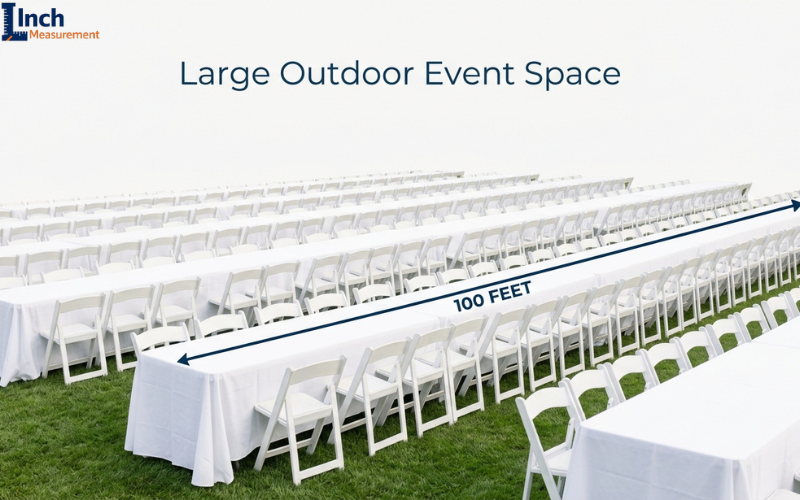
A large outdoor event space can measure around 100 feet across, depending on how it is designed. Such a space might be used for a wedding, festival, community event, market, or outdoor gathering.
Imagine an open area filled with rows of chairs, tables, food stalls, decorations, and walking space. Standing at one end and looking toward the other can help you picture the distance.
Event spaces come in many different sizes, so this is not an exact standard. However, a large open area around 100 feet wide provides a useful everyday comparison. It also shows that 100 feet can cover a surprisingly large amount of open space.
10. Small Commercial Parking Row
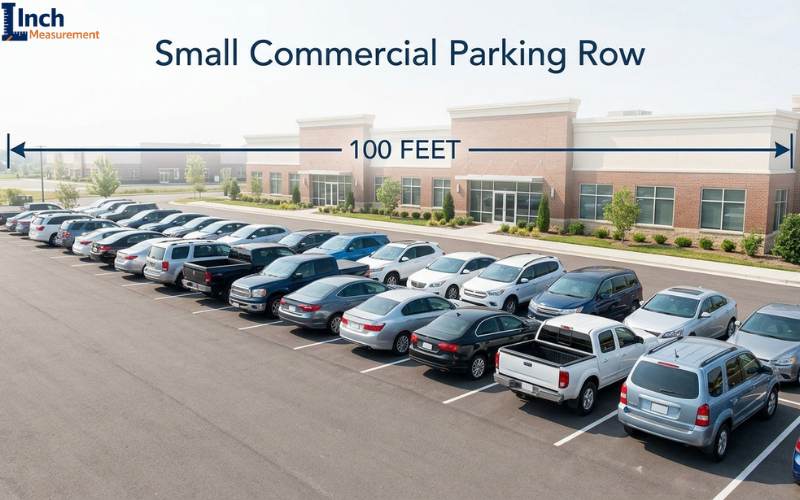
A small commercial parking row can extend close to 100 feet, depending on the layout and number of parking spaces. You might find a row like this outside a store, office, restaurant, or small shopping center.
Imagine walking from one end of a long parking row to the other while cars sit along the spaces. The vehicles, parking spaces, and driving area can quickly create a substantial distance.
Parking lots are not built to one exact size, so this is only an approximate comparison. Still, because most people are familiar with parking areas, a long commercial parking row can make 100 feet much easier to picture.
11. A Large Yacht
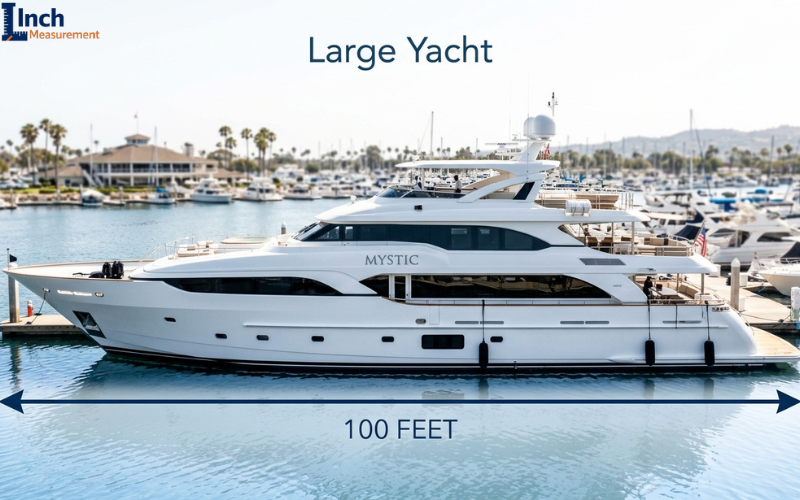
Many luxury yachts measure around 100 feet in length. These vessels are designed for comfort, travel, and performance, making them a strong example of this measurement.
A yacht of this size can include multiple rooms, decks, and amenities. Visualizing its length helps you understand how much space 100 feet provides in a real-world structure.
This example is useful for those interested in marine design or large-scale transportation.
12. The Length of a Blue Whale
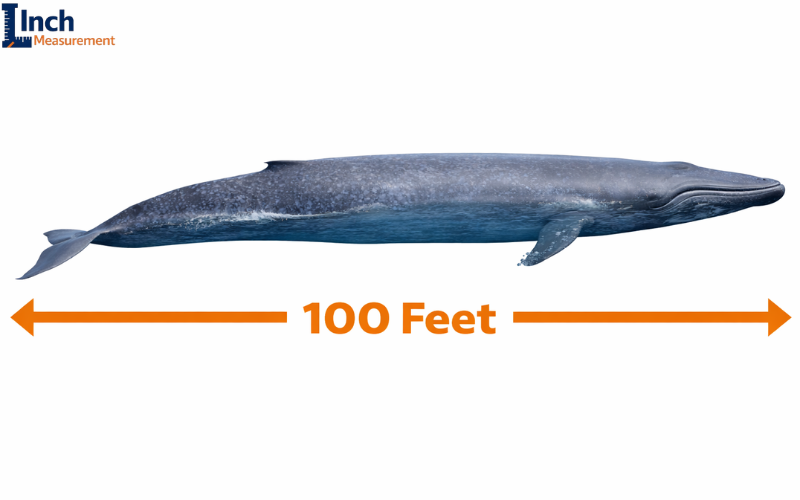
A blue whale, the largest animal on Earth, can grow up to about 100 feet long. This makes it a perfect natural example of this measurement. Imagining such a massive creature helps you understand just how long 100 feet really is.
To put it into perspective, a blue whale is longer than most buildings are wide and significantly larger than any land animal. Its size gives a powerful visual reference for this length.
This comparison is especially useful for educational purposes, as it combines measurement with real-world biology. It also shows how nature can produce structures that match large human-made dimensions.
More free measurement guides:
- 13 Common Things That Are 80 Feet Long
11 Common Things That Are 70 Feet Long - 13 Common Things That Are 60 Feet Long
- 12 Common Things That Are 50 Feet Long
- 11 Common Things That Are 40 Feet Long
- 12 Common Things That Are 30 Feet Long
- 12 Common Things That Are 20 Feet Long
FAQs
1. How long is 100 feet?
100 feet equals 1,200 inches, 33.33 yards, or 30.48 meters.
2. What does 100 feet look like?
Large objects like a school playground, crane boom, yacht, or mature tree can help you picture 100 feet.
3. How many steps are 100 feet?
For most adults, 100 feet is about 35–40 steps, depending on stride length.
4. How can I measure 100 feet?
You can use a 100-foot measuring tape, laser measure, or estimate the distance using your average step length.
How many inches are in 100 feet?
There are 1,200 inches in 100 feet.
How long is 100 feet compared to a football field?
A football field is 300 feet long, so 100 feet is about one-third of the field.
How long does it take to walk 100 feet?
At a normal walking speed, it takes about 20 to 25 seconds.
Is 100 feet considered a long distance?
Yes, it is a significant length, especially in indoor spaces or construction projects.
What is the easiest way to visualize 100 feet?
Think of 12 cars lined up or a basketball court length.
Conclusion
100 feet is a useful distance to understand because it appears in many real-life settings. It equals 30.48 meters or 1,200 inches, but numbers alone may not give you a clear picture. Comparing 100 feet with things such as a large playground, crane boom, yacht, or mature tree makes the length easier to imagine. Whether you are measuring a property, planning a project, or simply trying to understand distance, these real-world comparisons can help you picture just how long 100 feet really is.
