
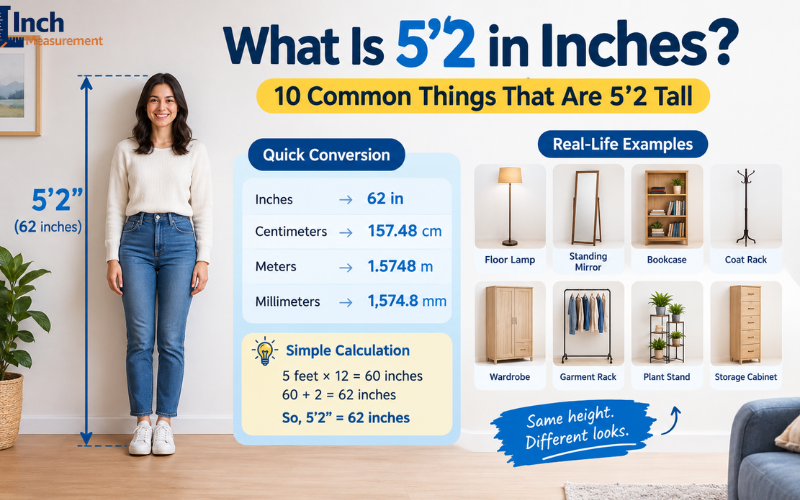
5’2 is equal to 62 inches. A height of 5 feet 2 inches is also 157.48 centimeters or 1,574.8 millimeters. If you need the exact answer to “what is 5’2 in inches?”, the answer is 62 inches.
This simple conversion is useful when a form, clothing chart, furniture guide, or measurement tool asks for height in inches instead of feet and inches. You may also see the same measurement written as 5’2, 5 ft 2 in, or 5 feet 2 inches in inches.
In centimeters, 5’2 is 157.48 cm, which is about 157.5 cm when rounded to one decimal place. Knowing these numbers can help you compare heights, check product sizes, or enter your measurement correctly online.
The key point is easy to remember: 5’2 in inches equals 62 inches. This article explains the conversion clearly and shows how 62 inches compares with everyday objects and common measurements, avoiding common conversion mistakes.
What Does 5’2 Mean?
When someone writes 5’2″, they mean 5 feet and 2 inches tall. The apostrophe after the 5 represents feet, while the quotation mark after the 2 represents inches.
You may also see the same measurement written as:
- 5 ft 2 in
- 5 feet 2 inches
- 5’2″
- 62 inches
These all describe the same height.
It is worth keeping the symbols straight when reading a measurement. 5’2″ means 5 feet 2 inches, while 5.2 feet is a decimal measurement and does not mean exactly the same thing.
In decimal feet, 5 feet 2 inches is about 5.17 feet because 2 inches is one-sixth of a foot.
5’2 in Inches, Centimeters, and Millimeters
If you are comparing measurements from different countries or using a product specification, you may need more than the inch measurement.
The exact conversions are:
- 5’2 = 62 inches
- 62 inches = 157.48 centimeters
- 62 inches = 1,574.8 millimeters
- 62 inches = 1.5748 meters
The centimeter figure comes from multiplying inches by 2.54:
62 × 2.54 = 157.48 cm
Because one centimeter contains 10 millimeters:
157.48 × 10 = 1,574.8 mm
For everyday use, 157.5 cm is usually accurate enough. If you are working with a technical drawing, manufacturing specification, or another situation where precision matters, use 157.48 cm.
Visualizing 62 Inches With Everyday Objects
| Item | Approximate Height |
|---|---|
| Tall Floor Lamp | 62 inches |
| Standing Mirror | 62 inches |
| Compact Bookcase | Around 62 inches |
| Small Wardrobe or Cabinet | Around 62 inches |
| Tall Coat Rack | 62 inches |
| Tall Plant Stand | Around 62 inches |
| Storage Cabinet | Around 62 inches |
| Compact Refrigerator | Around 62 inches |
| Full-Length Mirror | 62 inches |
| Children’s Furniture | Up to around 62 inches |
Tall Floor Lamp
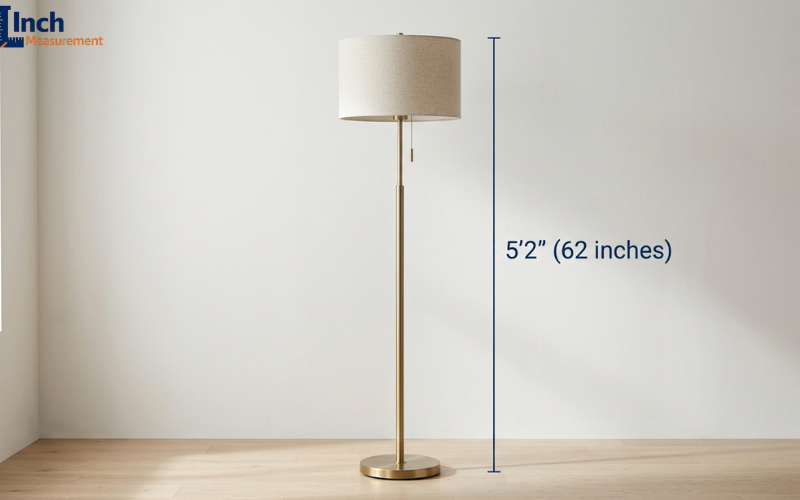
A floor lamp can be a good visual reference for 5’2, especially when the lamp has a long, upright body.
Floor lamps come in many sizes. Some are only a few feet tall, while others are considerably taller than 62 inches. A lamp measuring about 62 inches would stand roughly 5 feet 2 inches from the floor to its highest point.
This can help if you are choosing lighting for a room with limited space. A lamp that is 62 inches tall may provide a strong vertical element without reaching the height of a typical ceiling.
Remember that the lampshade can change the overall height. If a product listing says the stand is 58 inches and the shade adds another 4 inches, the total height would be 62 inches.
Standing Mirror
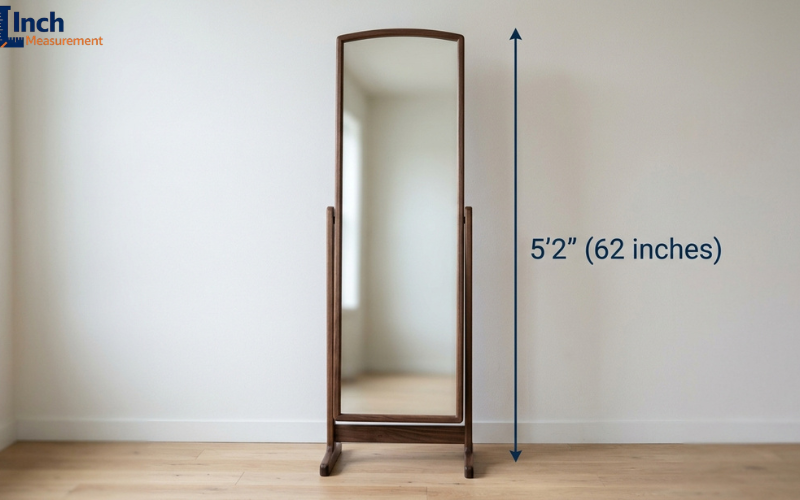
A standing mirror is another easy way to imagine 5’2 in inches.
A mirror that is 62 inches tall would be taller than many small wall mirrors and noticeably higher than a typical tabletop mirror. Whether it provides a complete head-to-toe reflection depends on the person’s height and the mirror’s position.
The mirror itself may not need to be exactly 62 inches to be useful. A mirror that is a few inches shorter or taller can still look very similar when you are trying to visualize the measurement.
If you are buying one, check the listed overall height, not just the glass height. A decorative frame, legs, or base may be included in the manufacturer’s measurement.
Related Post: What Is 60 Inches in Feet?
Compact Bookcase
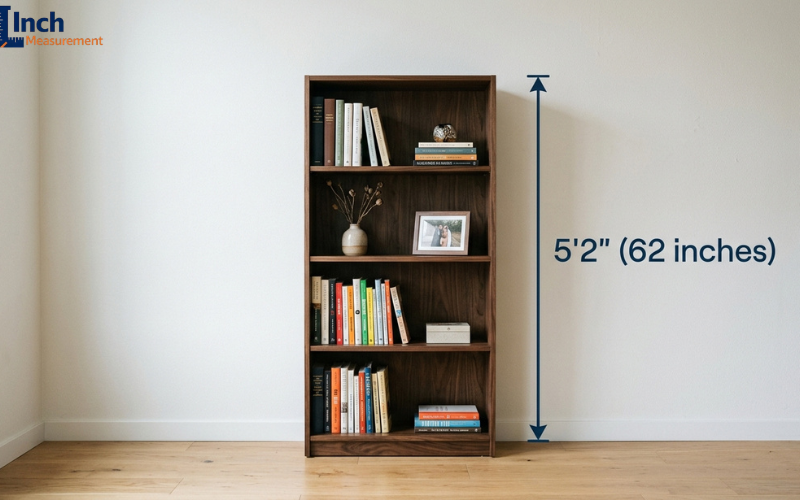
Some bookcases are close to 62 inches tall, making them another practical reference.
A bookcase at this height can hold several shelves while remaining easier to reach than a very tall unit. Shelf spacing may be around 10 to 12 inches, although adjustable shelves can change the layout.
For example, five shelf spaces of roughly 10 inches each would account for about 50 inches, with the remaining height taken up by the shelf boards, top, and base.
If you are measuring a space for a bookcase, do not use 62 inches as a guaranteed standard size. Measure the actual product because bookcases are manufactured in many different heights.
Small Wardrobe or Cabinet
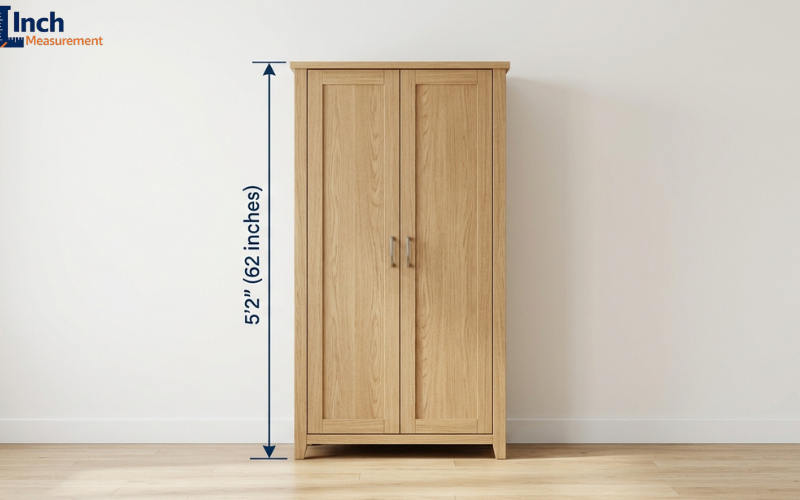
A compact wardrobe measuring around 62 inches can work well in rooms where a full-height storage unit would feel too large.
This is particularly useful for children’s rooms, guest rooms, apartments, and other spaces where you want storage without filling the entire wall.
Imagine a wardrobe that is 62 inches high and 30 inches wide. Its height is slightly more than five feet, while its width is less than three feet. Thinking about both dimensions together gives you a much better sense of its physical size than looking at the height alone.
Tall Coat Rack
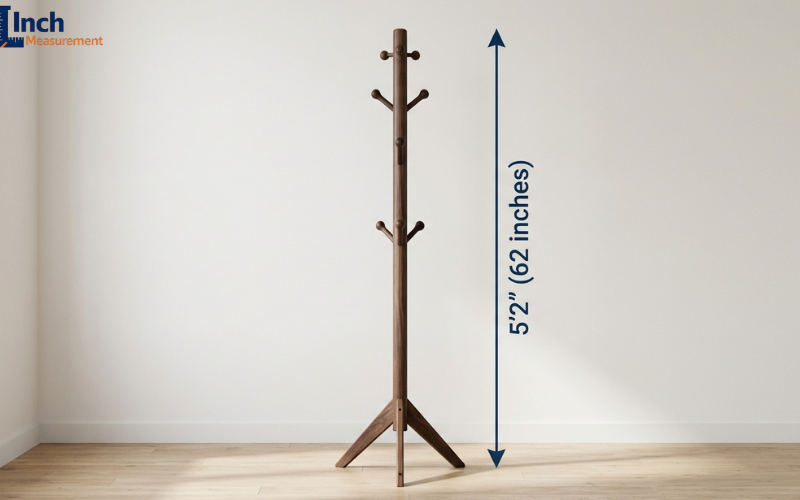
A tall coat rack can also help you picture a 5’2 measurement.
A rack that reaches 62 inches gives you enough vertical space for coats, jackets, bags, or other items. The hooks might be positioned at different heights rather than evenly spaced.
If you are installing a coat rack, height should be chosen based on the people using it. A 62-inch rack may be convenient for some adults but too high for young children.
This is a good reminder that a measurement can be technically correct while still being unsuitable for a particular purpose.
Tall Plant Stand
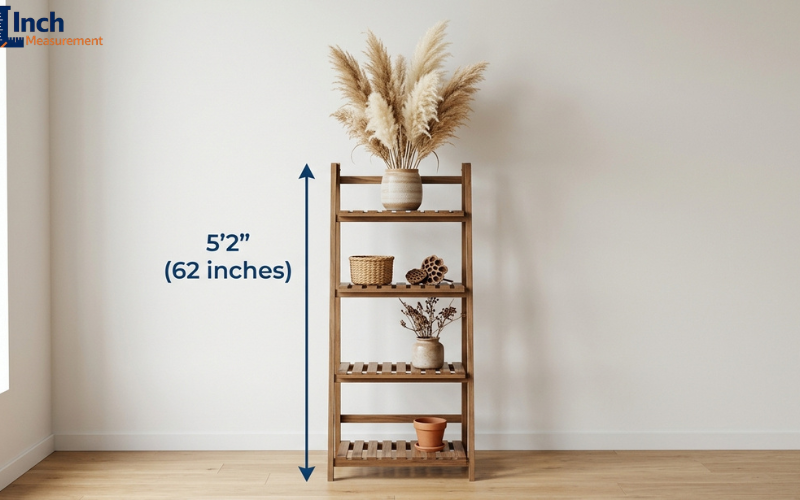
A multi-level plant stand around 62 inches high can give you another clear visual comparison.
Unlike a single solid object, a plant stand may have several shelves separated by open space. The total height still measures from the floor to the highest point.
For example, if the stand has four levels and is 62 inches tall, the individual gaps do not need to be 15.5 inches each. The shelves themselves, frame, feet, and uneven spacing all contribute to the overall height.
This is why you should always measure the outside dimensions when comparing an object with 5’2.
Storage Cabinet
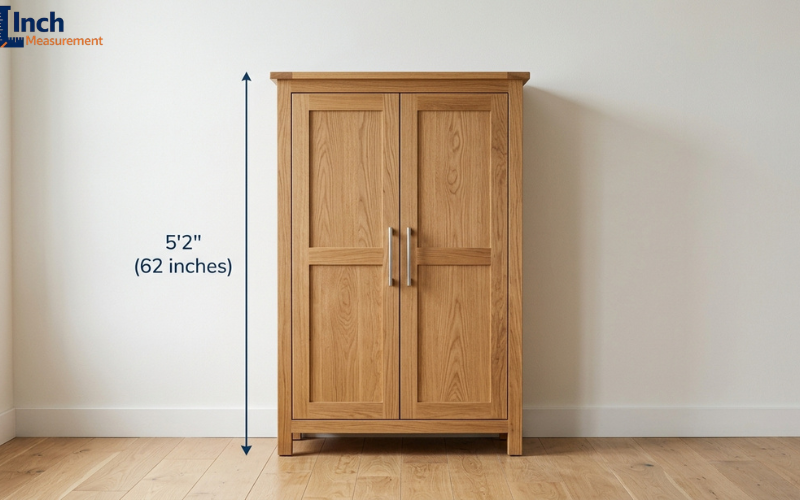
An office or home storage cabinet can sometimes be close to 62 inches tall.
The measurement becomes useful when planning where the cabinet will fit. Suppose a room has a low shelf, window, or other obstruction. Knowing that 5’2 equals 62 inches lets you compare the available vertical space with the cabinet’s listed height.
For example, if the available opening is 64 inches, a 62-inch cabinet would technically leave 2 inches of clearance. That sounds sufficient, but you should still account for uneven flooring, trim, hinges, and the way the cabinet needs to be moved into position.
Compact Refrigerator
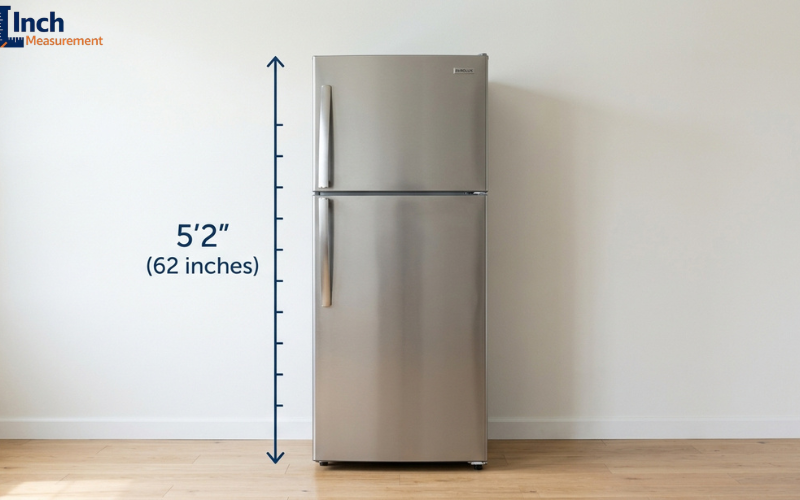
Some compact or specialty refrigerators can approach five feet in height, although refrigerator sizes vary widely.
If a refrigerator is listed as 62 inches high, that does not mean it will fit into every space that is 62 inches tall. Appliances usually need additional clearance for ventilation and installation.
This is one area where a conversion is only the first step. If you are replacing an appliance, check the manufacturer’s required clearance rather than assuming that equal measurements will fit.
Full-Length Mirror
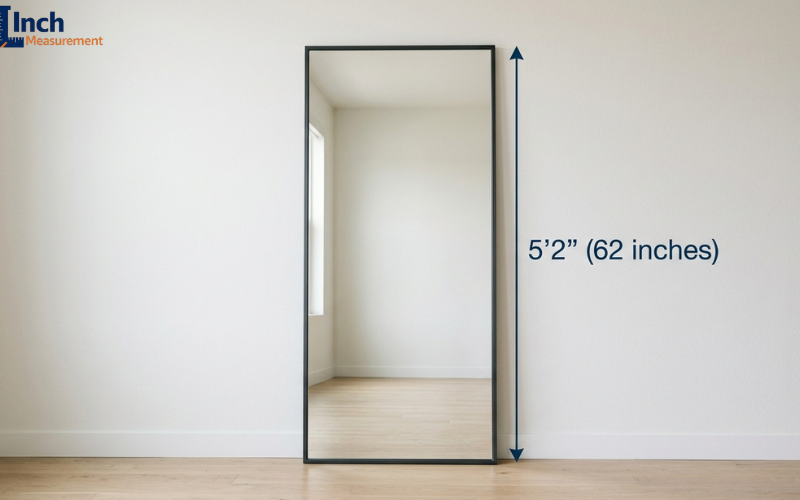
A full-length mirror is especially useful for understanding vertical measurements because you can compare it directly with a person.
A 62-inch mirror is roughly 5 feet 2 inches tall. Depending on how it is mounted and the viewer’s height, it may provide a full-body view or leave some areas outside the reflective surface.
The placement matters too. A mirror resting on the floor, leaning against a wall, or mounted above the floor can produce different viewing results even when the mirror itself has the same height.
Children’s Furniture
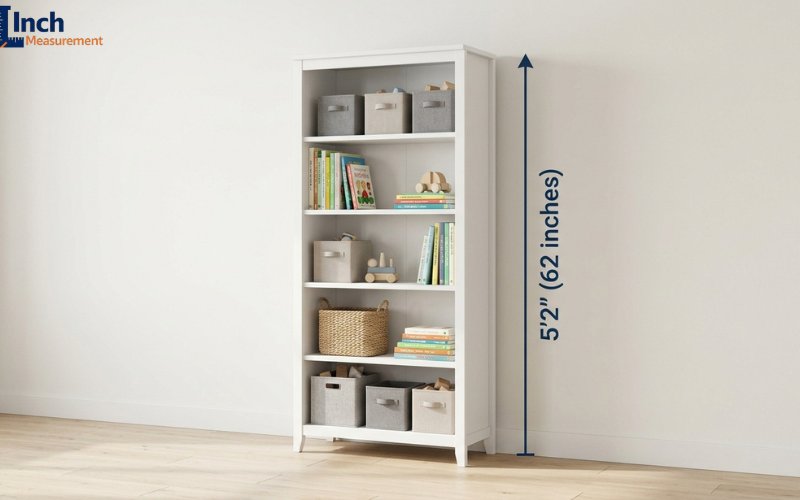
Some children’s furniture, play structures, shelves, and bunk-bed designs can approach 62 inches in total height.
However, this category needs extra care because product dimensions vary greatly. A bunk bed listed as 62 inches high refers to the complete structure, not the height of either mattress.
If you are checking a child’s room, measure from the floor to the highest fixed point. Also check the manufacturer’s safety instructions, especially around ceiling clearance and the space above the upper mattress.
How to Estimate 5’2 Without a Measuring Tape
You can make a rough estimate of 62 inches without carrying a ruler, but these methods are only approximations.
Your own body measurements can help. For instance, the distance from the floor to a particular point on your body can serve as a rough reference if you already know that measurement. Do not assume that everyone’s arm span, hand width, or stride is identical.
A standard sheet of paper is 11 inches long on its longer side. Five sheets placed end-to-end would measure 55 inches, leaving another 7 inches to reach 62 inches. That is useful for a rough demonstration, although keeping the sheets perfectly aligned is difficult.
A 12-inch ruler is more reliable. Five rulers give you 60 inches, and another 2 inches brings the total to 62 inches.
For anything involving construction, furniture installation, cutting material, or buying a replacement part, use a proper measuring tool instead of an estimate.
5’2 Compared With 10 Feet
A 10-foot measurement is useful for room planning.
Ten feet equals 120 inches, while 5’2 equals 62 inches. So, 5’2 is just over half of 10 feet.
The difference is:
120 − 62 = 58 inches
If you are looking at a room with a 10-foot ceiling, an object that is 62 inches tall would occupy a little more than half of that vertical space.
This comparison can also help when planning tall furniture. A 62-inch cabinet under a 10-foot ceiling would leave 58 inches of vertical space above it, before accounting for any other fixtures.
What If You Need to Measure a 62-Inch Space?
Start by measuring from the actual floor or starting point to the highest point available. Keep the measuring tape straight instead of following a wall’s curve or an uneven surface.
If the available height is exactly 62 inches and the object is also exactly 62 inches, there is effectively no installation clearance. That may be a problem for furniture or appliances that need to be tilted, lifted, or ventilated.
For a tight space, it is better to have some extra room. If your opening is 65 inches and the item is 62 inches, you have 3 inches of vertical clearance.
The same principle applies horizontally. A product’s height may fit perfectly while its width or depth prevents it from being installed.
Common Mistakes With 5’2 Measurements
The most common error is treating the measurement as a decimal.
5’2 means five feet and two inches, not 5.2 feet.
Another mistake is forgetting that each foot contains 12 inches. The calculation should always start with:
5 × 12 = 60
Then:
60 + 2 = 62
People also sometimes confuse height with width or depth in product listings. If a cabinet is listed as 62 inches high, 30 inches wide, and 15 inches deep, only the first measurement corresponds to the 5’2 comparison.
Finally, be careful with rounding. 157.48 cm is the precise centimeter conversion, while 157 cm is a rounded figure. Either may be suitable depending on what you are doing, but they are not equally precise.
Related Post: 10 Common Things That Are 6 Feet Long
Frequently Asked Questions
What is 5’2 in inches?
5’2 is 62 inches. Five feet equals 60 inches, and the additional 2 inches bring the total to 62.
How many inches is 5 feet 2 inches?
5 feet 2 inches is 62 inches. The calculation is 5 × 12 + 2 = 62.
How tall is 5’2 in centimeters?
5’2 is 157.48 centimeters. It is often rounded to 157.5 cm for everyday use.
Is 5’2 the same as 5.2 feet?
No. 5’2 means 5 feet 2 inches, while 5.2 feet is a decimal measurement. Five feet two inches is approximately 5.1667 decimal feet.
How many millimeters is 5’2?
Since 5’2 equals 62 inches, it converts to 1,574.8 millimeters.
What is 62 inches in feet and inches?
62 inches is 5 feet 2 inches. Divide 62 by 12 to get 5 full feet with 2 inches remaining.
Is 5’2 a little over 5 feet?
Yes. Five feet is exactly 60 inches, so 5’2 is 2 inches taller than 5 feet.
How can I visualize 62 inches?
Think of a vertical object around five feet tall, such as a tall mirror, bookcase, or floor lamp. You can also picture five 12-inch sections plus another 2 inches.
Is 62 inches exactly 5’2?
Yes. Five feet contains 60 inches, and adding 2 inches gives exactly 62 inches.
Why do I see 5’2″ written with two symbols?
The apostrophe ‘ represents feet, while the quotation mark “ represents inches. Therefore, 5’2″ means 5 feet and 2 inches.
Final Answer
If you are searching for what is 5’2 in inches, the exact answer is 62 inches. Five feet gives you 60 inches, and the extra 2 inches bring the total to 62.
The same measurement is 157.48 cm, 1,574.8 mm, or 1.5748 meters. Once you know the conversion, it becomes much easier to compare 5’2 with furniture, room dimensions, mirrors, lamps, storage units, and other everyday measurements.
The key calculation is simple:
5 feet × 12 inches = 60 inches
60 inches + 2 inches = 62 inches
So whenever you see 5’2, 5 feet 2 inches, or 62 inches, you are looking at the same measurement.
